

Reach for a cane after a bad knee or hip, and instinct says hold it on the sore side. That instinct is backwards.
The cane belongs in the hand opposite the leg that hurts, not the one that needs help. Get that one detail wrong and the cane barely widens your base or takes any weight off the joint that needs it.
It sounds like a small technicality. It is not.
A cane usually shows up after a knee replacement, a hip that aches on one side, or a knee arthritis flare. Many of those knees also respond to changes that ease pressure on the joint.
Whatever the reason for the cane, which hand holds it decides whether it helps at all.
The hand almost everyone gets backwards
Hold the cane in the hand opposite your weak or painful leg. Not the same side. The opposite one.
It feels wrong at first. Most people’s instinct is to brace the bad leg with the nearest hand, the one right beside it.
That instinct narrows your base of support instead of widening it. A cane on the same side barely helps.
Here is why the opposite hand works. In ordinary walking, your right arm already swings forward with your left leg, and the left arm swings with the right leg.
Holding the cane opposite lets it move with that same rhythm, and it can genuinely take weight off the hip or knee that hurts. Orthopaedic guidance is direct about this: the cane belongs opposite the side that needs support.
Held on the painful side instead, the cane sits too close to the leg doing the work. It barely widens your stance and takes almost no load off the joint you are protecting.
Getting the height right
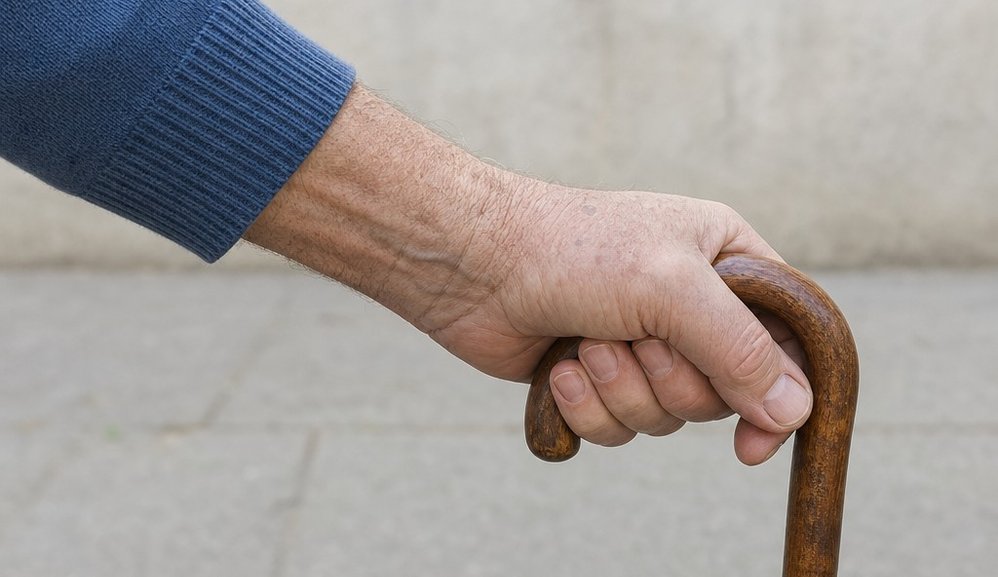
Stand up straight in the shoes you would normally walk in, and let your arm hang loose at your side.
The top of the cane should reach the crease of your wrist, right where your hand bends. Get it there and your elbow settles into a bend of about 20 degrees on its own.
Too tall is the common mistake, more often than too short.
A cane cut too long pushes your shoulder up toward your ear with every step. It tires your arm fast and gives you less support, not more.
The cane should not hug your foot, either. Let it sit about 4 to 6 inches out from your leg, not tucked in tight against it.
Quick checks before your first walk:
- Stand upright in your usual walking shoes, arm relaxed at your side.
- The top of the cane should meet the crease of your wrist.
- Your elbow should bend gently, not straighten out or fold sharply.
- Check the rubber tip. A worn, smooth tip slides the same way a worn shoe sole does.
The rhythm that makes it work
Once the hand and the height are right, the gait follows almost on its own.
Move the cane forward at the same moment as your weak leg. Then step through past both of them with your stronger leg.
Think of the cane and the weak leg as one unit that travels together. Get that pairing right and the rhythm looks after itself, over and over.
It will feel mechanical for the first few outings. Most people stop thinking about it within a week or two.
Stairs are where the mistake costs the most
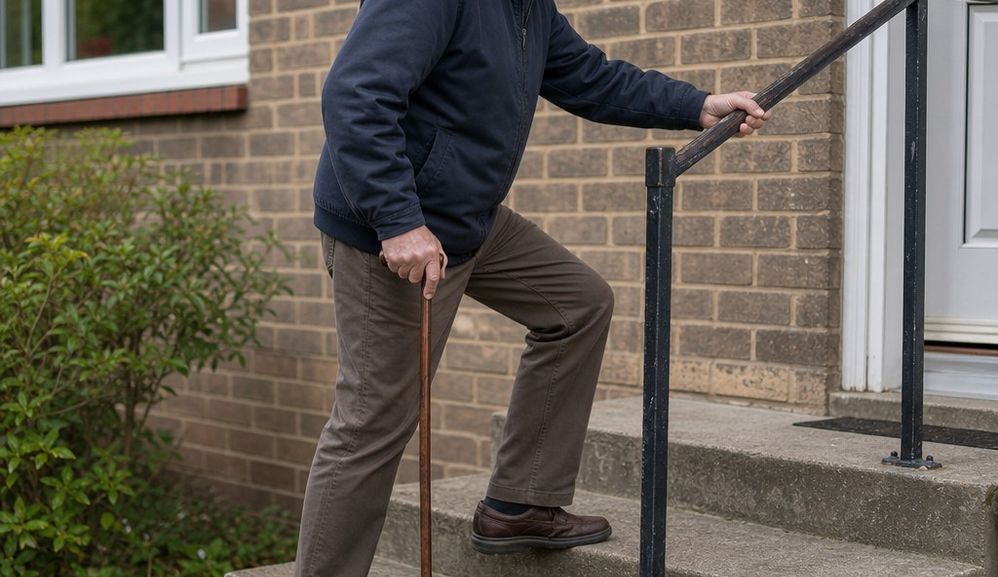
Stairs are where getting this wrong actually hurts, not just where it feels awkward.
Going up, lead with your strong leg. Bring the weak leg up next, and the cane follows last.
Going down, reverse the order. The cane goes first, then the weak leg, then the strong leg finishes the step.
There is an old memory aid for this. It is worth learning by heart rather than working it out mid-staircase: “up with the good, down with the bad.”
Say it to yourself before the first step. The moment you actually need it is a bad moment to be guessing.
Use the handrail whenever there is one, cane or no cane.
A cane and a pair of poles solve different problems
It is easy to assume a cane and a pair of walking poles are just two versions of the same idea. They are not.
Poles come as a pair and load both sides evenly. They are built for rhythm and propulsion, and for staying steady on uneven ground like a rooted trail or loose gravel.
A cane is one tool doing one job. It unloads a single bad hip, knee, or ankle on ordinary, flat surfaces.
Poles share the load evenly across both sides for rhythm and rough ground. A cane does the opposite, unloading one bad side on ground that is already flat.
Reach for poles to fix a one-sided hip problem, and you have picked the wrong tool for the job.
When a cane isn’t the right tool anymore
A cane has a real limit, and it is worth knowing exactly what it is.
A cane can only safely support about 25 percent of your body weight. A walker can support roughly half.
That is not a rough guess. It reflects the physical difference between balancing on one point of contact and a wide, four-legged base.
More than one in four adults age 65 and older fall each year. A cane that is the wrong height, or held on the wrong side, adds needless risk to that number.
A few signs a cane is no longer enough:
- You are leaning hard on furniture to get around the house.
- You need both hands for stability, not one.
- Your balance keeps getting worse instead of holding steady.
If any of that sounds familiar, improvising with a taller cane, or two canes, is not the fix.
Balance that keeps slipping is not simply what age does to everyone.
It has causes, and the National Institute on Aging lists several: problems with the nerves, feet, thyroid or blood vessels all affect balance.
Medicines count too, since some cause dizziness or confusion as a side effect, and the risk climbs with the number you take.
A cane that fits, held in the correct hand, at the correct height, still supports only about a quarter of your body weight.
What actually helps depends on the cause.
If numb or tingling feet are part of your picture, walking when your feet have lost some feeling comes with precautions of its own.
Sorting that out is a question for an examination, not for a bigger cane.
This is information, not a diagnosis, and it cannot examine your legs or your balance the way a doctor or physical therapist can.
New pain that is sharp, one-sided, or unfamiliar is a signal to get looked at, not a reason to push through on your own.
Sorting that out is a question for an examination, not for a bigger cane.
The American Academy of Orthopaedic Surgeons notes that some people need more help with balance and walking than a cane can give. This is common after a total knee or hip replacement, or another significant problem.
That is not a failure. It is a different tool for a different stage. The goal stays the same either way: walking safely for years, not making do with something that is almost right.
A cane that fits, held in the correct hand, at the correct height, still supports only about a quarter of your body weight. Past that point, the answer is a walker, not a taller cane.
A note before you go: this is general information rather than medical advice. If you have a condition that affects your feet, your balance, or your heart, check with your doctor about what pace and distance make sense for you.