

The Drive Medical Nitro Rollator is the one to start with, since Drive lists its 10-inch front wheels for curbs and rough terrain.
A rollator is a four-wheeled walker with hand brakes and a built-in seat. You push it instead of lifting it, and you can sit when your legs tire.
This is general information, not medical advice.
WoodsWalk may earn a small commission when you buy through the Amazon links here, and your cost stays the same.
The five rollators, sorted by front wheel size:
- Drive Medical Nitro Rollator: 10-inch front wheels, one-hand fold. The default for curbs and rough paths.
- Drive Medical Nitro Heavy-Duty Rollator: 10-inch front wheels, independent suspension, supports up to 450 lb.
- Drive Medical Nitro Sprint Rollator: front wheel size not stated on the listing. Three brake modes, including one for downhill.
- Hugo Mobility Portable Rollator: 8-inch wheels, listed for indoor and outdoor surfaces.
- Hugo Mobility Sidekick Rollator: 8-inch front and 6-inch rear wheels, folds by a pull strap on the seat.
Drive Medical Nitro Rollator
Curbs and rough park paths, with a seat for the walk back.
 Drive Medical Nitro Foldable Rollator Walker with Seat
10-inch front casters
Push-button handle height, one-hand fold
Look up your size and the price on Amazon
Drive Medical Nitro Foldable Rollator Walker with Seat
10-inch front casters
Push-button handle height, one-hand fold
Look up your size and the price on Amazon
Its 10-inch front casters (small swiveling wheels) are the largest stated on this page, matched only by the Heavy-Duty.
The handles adjust by push button, and the backrest moves with a thumb screw that needs no tools.
- Made for
- A fold with one hand and an under-seat lock, so it goes in a car trunk
Drive Medical Nitro Heavy-Duty Rollator
A walker with a stated weight limit and suspension for rough ground.
 Drive Medical Nitro Heavy-Duty Foldable Rollator Walker
10-inch front casters, independent suspension
Supports up to 450 lb, one-hand fold
Look up your size and the price on Amazon
Drive Medical Nitro Heavy-Duty Foldable Rollator Walker
10-inch front casters, independent suspension
Supports up to 450 lb, one-hand fold
Look up your size and the price on Amazon
It adds independent suspension to the Nitro’s 10-inch front wheels. Drive pairs the two for rough terrain.
The frame is aluminum with a cross-brace, and the brake wires are hidden.
- Made for
- Supports up to 450 lb, the only weight limit stated on any of the five listings
Drive Medical Nitro Sprint Rollator
Routes with a hill, where you want the brakes to hold the speed down.
 Drive Medical Nitro Sprint Foldable Rollator Walker
Free, park and slowdown brake modes
Three bag positions, one-hand fold
Look up your size and the price on Amazon
Drive Medical Nitro Sprint Foldable Rollator Walker
Free, park and slowdown brake modes
Three bag positions, one-hand fold
Look up your size and the price on Amazon
Its brakes have three modes, free, park and slowdown, and Drive lists the slowdown mode for downhill control. A flat mall loop never asks for that; a sloping park path does.
It also has a wide padded seat, a contoured backrest and three bag-mounting positions. No front wheel size or weight limit is given, so ask the seller for both.
- Unsuited to
- Anyone choosing on wheel size: the listing does not state it
Hugo Mobility Portable Rollator
Mostly smooth sidewalks and paths, with an 8-inch wheel.
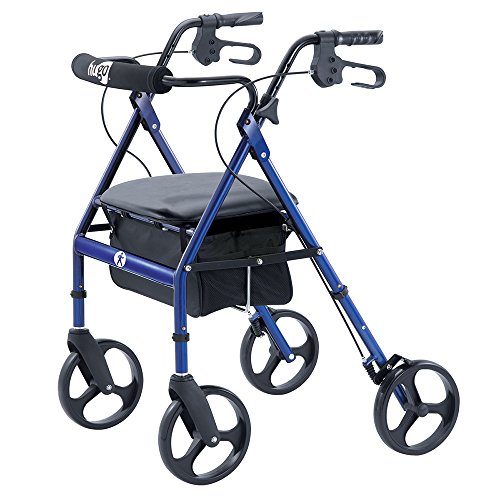 Hugo Mobility Portable Rollator with Seat and Backrest
8-inch casters, indoor and outdoor surfaces
Padded backrest, tool-free assembly
Look up your size and the price on Amazon
Hugo Mobility Portable Rollator with Seat and Backrest
8-inch casters, indoor and outdoor surfaces
Padded backrest, tool-free assembly
Look up your size and the price on Amazon
Hugo gives it 8-inch casters for indoor and outdoor surfaces. That is two inches smaller than the Nitro’s front wheels, so choose it for paved routes rather than rough ones.
It also has a lightweight frame and storage bags.
- Made for
- A patented handle shape made to fit the palm
- Unsuited to
- Rough ground where you want a 10-inch front wheel (the Nitro)
Hugo Mobility Sidekick Rollator
Frequent car trips, with a fold you can do by pulling up the seat strap.
 Hugo Mobility Sidekick Foldable Rollator Walker with Seat
8-inch front and 6-inch rear wheels
Seat-strap fold, removable mesh bag
Look up your size and the price on Amazon
Hugo Mobility Sidekick Foldable Rollator Walker with Seat
8-inch front and 6-inch rear wheels
Seat-strap fold, removable mesh bag
Look up your size and the price on Amazon
It has the smallest wheels of the four that state a size: 8 inches at the front and 6 at the rear. In exchange, it folds when you pull up on the seat strap.
- Made for
- Hugo's description of it as ultra-lightweight, with a one-handed fold
- Unsuited to
- Rough paths: its rear wheels are 6 inches
Rollator, cane or standard walker
A cane takes some load off one leg. A standard walker has no wheels, so you lift it and set it down at every step. A rollator rolls.
A rollator suits a longer walk on a sidewalk or park path where you want to sit. The seat is the feature a cane and a standard walker do not have.
You push a frame the whole way, and it has to fit in your car. If you only need a little help for short steps, a cane may still do.
Measure before you choose
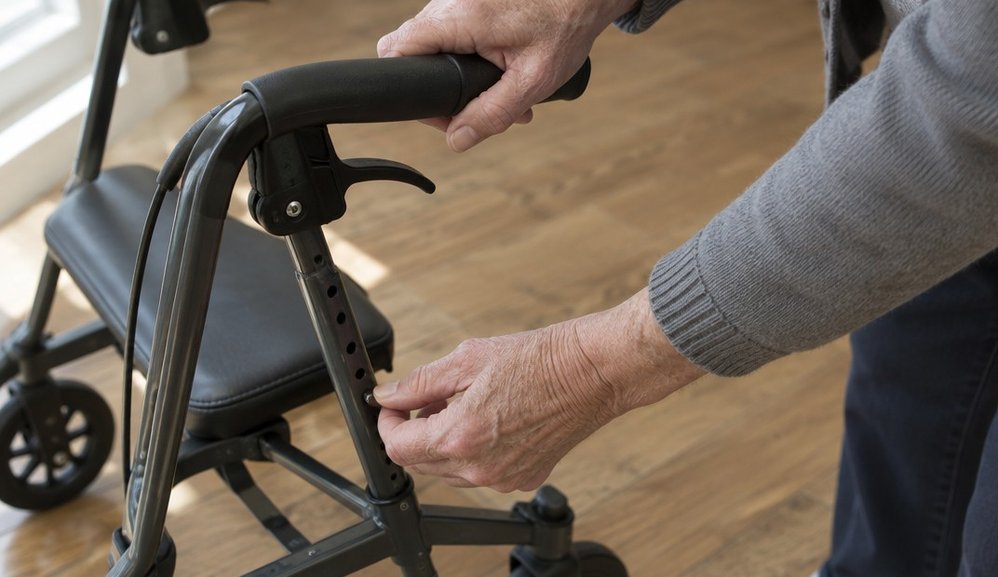
MedlinePlus, the National Library of Medicine’s health information site, says a walker should be adjusted to your height, with the handles at the level of your hips.
Your elbows should be slightly bent when you hold the handles. Check the seat height against your own legs before you buy.
Of the four that state a size, front wheels run from 10 inches down to 8, and the Sidekick’s rear wheels are 6.
If you drive to your walks, check that you can lift it into the trunk. None of the five listings states the rollator’s own weight in pounds, so ask before you buy.
Which rollator for which route
| Your walk | Take a look |
|---|---|
| Curbs and rough park paths | Drive Medical Nitro Rollator |
| Rough ground and a stated weight limit | Drive Medical Nitro Heavy-Duty Rollator |
| A hill with a long downhill stretch | Drive Medical Nitro Sprint Rollator |
| Smooth sidewalks and paved paths | Hugo Mobility Portable Rollator |
| Frequent car trips and a seat-strap fold | Hugo Mobility Sidekick Rollator |
Worth paying for
- Front wheels of 10 inches, if your route has curbs or rough ground. Only the Nitro and Nitro Heavy-Duty state that size.
- A brake that can hold on a slope. Only the Nitro Sprint lists a downhill mode.
Not worth paying for
- Independent suspension, if your walks stay on smooth pavement. Only the Nitro Heavy-Duty lists it.
- A rollator you cannot lift into your car, however well it rolls.
Will Medicare pay for one?
Medicare, the federal health insurance program for people 65 and over, lists rollators under walkers.
Medicare Part B covers a walker, including a rollator, when your provider prescribes it as medically necessary for use in your home. After the Part B deductible you pay 20% of the Medicare-approved amount if the supplier accepts assignment.
The supplier must be enrolled in Medicare.
The page speaks of use in your home. If your reason is walking outside, ask your doctor and the supplier whether a rollator bought for that purpose is covered.
When to see a physical therapist first
You may not need a rollator at all if a cane still carries you through the walk. Leaning hard on furniture, needing both hands, or balance that keeps getting worse can mean a cane is not enough any more.
If the fear of falling keeps you off the path, talk to your doctor or a physical therapist about it.
If your balance is getting worse, or you have had a fall or a joint replacement, ask a physical therapist before you buy. A therapist can help you choose and adjust a rollator.