
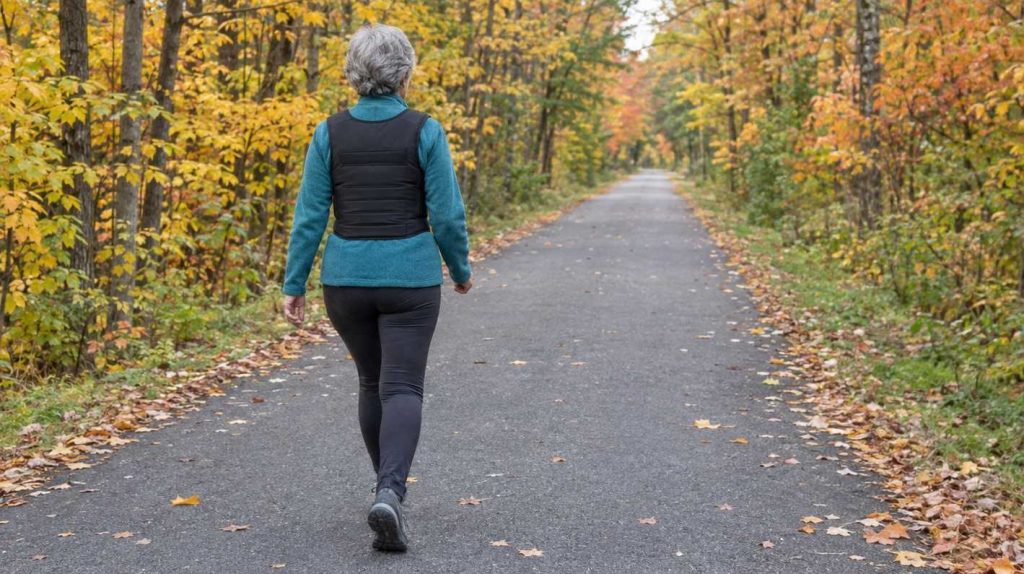
You keep seeing the claim that a weighted vest builds bone. For plain walking, that has not been shown.
The research is mixed, and a 150-person trial from 2025 was a miss.
A vest adds a little challenge to a walk. It is not a bone treatment. It can ask more of your back, neck and balance than an ordinary walk does.
What the 2025 trial found
The INVEST trial came from Wake Forest University School of Medicine in North Carolina. It was published in JAMA Network Open, a medical journal.
It enrolled 150 adults with an average age of 66. About three in four were women.
Everyone was losing weight, because weight loss in older adults is linked to bone loss. One group wore a vest on top of that. Another group added supervised resistance training.
The vest did not prevent hip bone loss. After 12 months, hip bone density had fallen by 1.2 to 1.9 percent in every group. The vest group did not differ from the group that only lost weight.
That is a plain null result.
Three limits matter here:
- The adults had obesity (average BMI 33.6), and all were losing weight.
- The vest was worn during daily activity, not only on walks.
- Average wear was 7.1 hours a day, short of the 8 hours asked for.
So the trial says a vest did not protect hip bone during weight loss.
It did not test a walker who stays at a steady weight.
The older study that looks more hopeful
A smaller study points the other way.
Researchers at Oregon State University followed 18 postmenopausal women for 5 years. Nine did vest exercise three times a week for 32 weeks of each year.
Nine active women were the comparison.
At the femoral neck, the top of the thigh bone, the exercisers’ bone density rose 1.54 percent. The comparison women lost 4.43 percent. At the whole hip, exercisers lost 0.82 percent and the others lost 3.80 percent.
Look at what the exercisers actually did. The routine was a vest plus jumping, not a walk. A 2026 review adds that the vest averaged 11.3 lb and the moves included squats, lunges and chair stands.
Eighteen women is also a very small group.
It is an encouraging sign, not proof that a walk in a vest does the same.
What about muscle and calories?
The INVEST team later looked at muscle. Differences between the vest group and the weight-loss-only group were not significant. The resistance training group did better, with muscle density up 3.7 to 5.9 percent.
A 2026 mini-review in Frontiers in Public Health, a journal, looked at 15 studies in adults 60 and older. It found low-load vests worn during normal life generally did not improve strength or bone.
Benefits showed up mostly when the vest was worn during planned exercise, with the load rising over time.
The sources read for this page give no calorie figure for walking in a vest. More weight to carry means more effort.
How much more depends on your pace and your load, and no trial here measured it.
How much weight, and how to add it
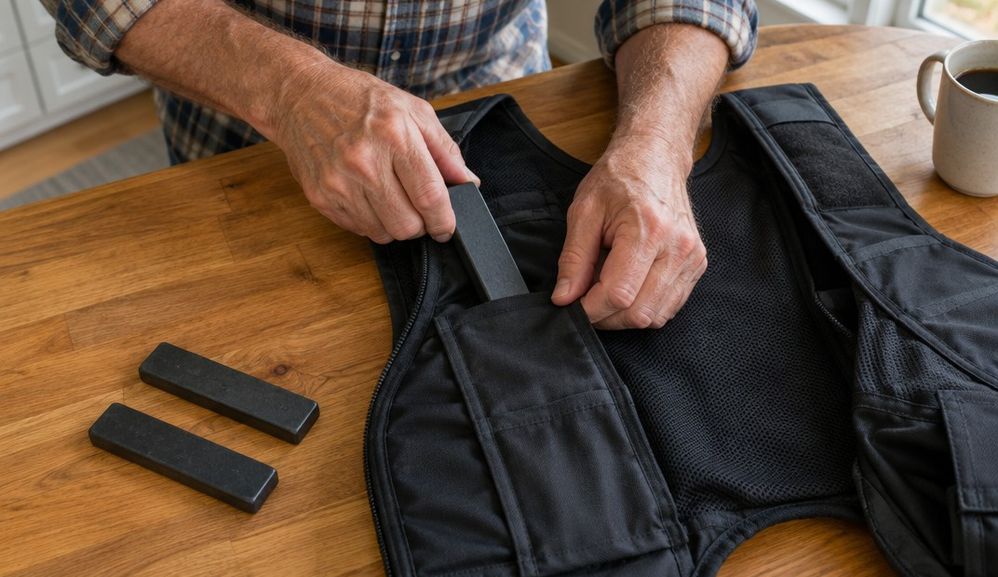
The 2026 mini-review suggests starting at 1 to 5 percent of body weight. First-time users start toward 1 to 3 percent.
It then suggests adding about 1 to 2 percent a week, only if your gait stays steady.
The review gives an order of change: more time first, then pace, then weight. Add weight last, and not in the same week as a longer walk.
No product is needed to begin.
A small backpack with a book or two is a rough stand-in for the first weeks.
If you want weights that come in small steps, the vests that start light are worth a look.
The plan below is a cautious approximation. It stays at or below 5 percent of body weight. The pounds assume a 160 lb walker, so do the math for your own weight.
| Weeks | Vest weight | Each walk |
|---|---|---|
| 1 | 1% (about 2 lb) | 15 min, 3 days |
| 2 | 1% (about 2 lb) | 20 min, 3 days |
| 3 | 2% (about 3 lb) | 20 min, 3 days |
| 4 | 2% (about 3 lb) | 25 min, 3 days |
| 5 | 3% (about 5 lb) | 25 min, 3 days |
| 6 | 3% (about 5 lb) | 30 min, 3 days |
| 7 | 4% (about 6 lb) | 30 min, 3 days |
| 8 | 5% (about 8 lb) | 30 min, 3 days |
Walk on flat, even ground. The mini-review advises against stairs and uneven ground while you are learning. If your hips, feet or lower back ache the next day, repeat the week before moving on.
Hold the weight while your step is unsteady or the walk feels harder than moderate.
Who should ask first, or skip it
Ask your doctor or a physical therapist before you start if you have:
- Back or neck pain, or a spinal condition
- Pelvic floor problems, such as leaking when you cough or lift
- Balance problems or a recent fall
- A recent fracture, a flare-up in a joint, or a heart or lung condition that is not under control
The mini-review lists some of these as reasons for caution or delay. One trial it covered recorded more falls in the vest group.
For the back, neck and pelvic floor, the caution is common sense: a vest adds load to the trunk.
Stop if you feel sharp, new or one-sided pain, dizziness, or a wobble in your step. A vest is optional. If it does not feel right, a walk without it is still a good walk.
If bone is your main concern, start with what walking itself does for bone density.
How a vest compares with other add-ons
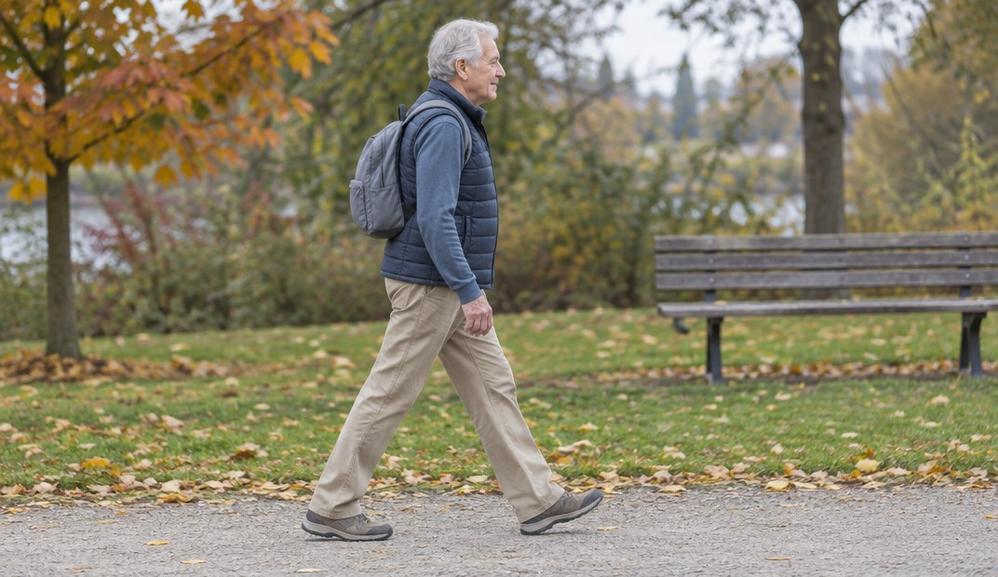
No trial in the sources above compared a vest with these options, so this is plain reasoning rather than research.
- Vest: the weight sits close to your body and spreads across your torso. Your arms swing as usual.
- Rucking: this means walking with a loaded backpack. The load sits higher and can pull on your shoulders and lower back. A well-fitted pack works, but check the fit.
- Ankle weights: the weight hangs at the end of the leg. It changes how your leg swings, so ask first if your hips or knees complain.
- Hand weights: they change your arm swing and can tire your shoulders. They add little extra load to your legs.
You do not need any of these to get benefit from walking.
Your own body weight is already a load.
In week 1, wear the vest at about 1 percent of your body weight for a 15-minute walk on flat ground, three days that week.