
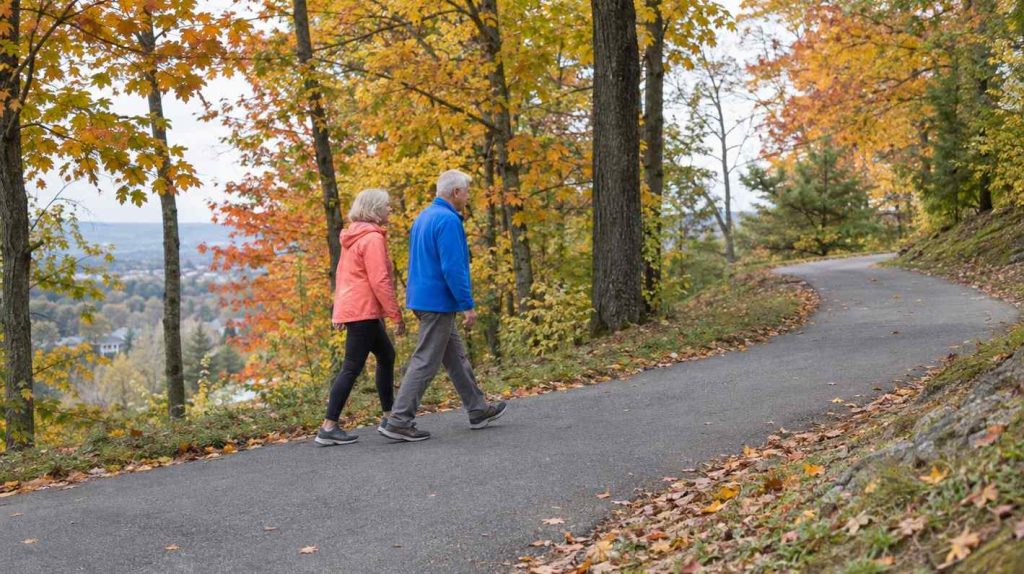
A 160 lb walker at an ordinary pace, about 2.8 to 3.2 miles an hour, burns about 156 calories in 30 minutes. That figure comes from the Older Adult Compendium, a table built from adults 60 and over.
Your own number is that same math with your weight and pace swapped in. The table below does the swapping for you.
This is general information, not medical advice. These are estimates, and a watch or a machine may show a different figure.
How the number is worked out
The Compendium of Physical Activities is a research catalog of the energy cost of everyday activities. Each activity gets a MET value, a multiple of the energy you use sitting still.
The older-adult edition appeared in 2024 in the Journal of Sport and Health Science. It sets the resting baseline at 2.7 milliliters of oxygen per kilogram per minute. Its authors call these values MET60+.
The Compendium team gives the conversion as: MET60+ times 0.810 kcal per kilogram per hour, times body weight in kilograms, times hours walked.
Calories burned = MET60+ x 0.810 x body weight (kg) x hours.
The METs used here, all for level walking on a firm surface:
- 2.2 to 2.7 mph: 4.5 METs
- 2.8 to 3.2 mph: 5.3 METs
- 3.3 to 3.7 mph: 6.0 METs
Calories in 30 minutes, by weight and pace
Every figure below is an estimate computed from those METs, rounded to the nearest calorie. Pounds are converted to kilograms first (1 lb is 0.4536 kg).
| Body weight | 2.2 to 2.7 mph | 2.8 to 3.2 mph | 3.3 to 3.7 mph |
|---|---|---|---|
| 120 lb | 99 | 117 | 132 |
| 140 lb | 116 | 136 | 154 |
| 160 lb | 132 | 156 | 176 |
| 180 lb | 149 | 175 | 198 |
| 200 lb | 165 | 195 | 220 |
| 220 lb | 182 | 214 | 242 |
A heavier walker burns more, and a faster pace burns more. Double the minutes and you double the figure.
A worked example at 160 pounds
A 160 lb walker weighs 72.6 kg. Take the middle pace, 5.3 METs, for 30 minutes (0.5 hours).
- 5.3 x 0.810 = 4.293 calories per kilogram per hour.
- 4.293 x 72.6 kg = 311.7 calories per hour.
- 311.7 x 0.5 hours = about 156 calories.
The same steps at the other two paces:
- 2.2 to 2.7 mph: 4.5 x 0.810 x 72.6 x 0.5 = about 132 calories.
- 3.3 to 3.7 mph: 6.0 x 0.810 x 72.6 x 0.5 = about 176 calories.
Going from 2.2 to 2.7 mph to 3.3 to 3.7 mph adds about 44 calories per half hour.
For comparison, the general 2024 Adult Compendium lists 3.8 METs for level walking at 2.8 to 3.4 mph. It converts MET to calories as MET x kilograms x hours, with no 0.810 factor.
For the same 160 lb walker that gives about 138 calories in 30 minutes.
The pace ranges are not identical, so treat that 18-calorie gap as a rough one.
How hills change the number
The Older Adult Compendium has one row with a slope: walking at 1.5 to 2.0 mph on a 2.5 to 5 percent grade, rated 5.0 METs. Level walking at 1.0 to 1.9 mph is rated 4.0 METs.
For the 160 lb walker, a half hour is about 147 calories uphill and about 118 level. The gentle slope adds roughly 29 calories at a similar slow pace.
The older-adult list stops there. The general Adult Compendium has more rows, for climbing hills with no load.
- 1 to 5 percent grade, moderate to brisk pace: 5.3 METs, about 192 calories in 30 minutes for the same walker
- 6 to 10 percent grade, moderate to brisk pace: 7.0 METs, about 254 calories
Those two use the general formula, so they are not directly comparable with the table above.
What a weighted vest does to the number
No row in either Compendium list covers a weighted vest. The general Adult Compendium rates level walking with a day pack in the city at 3.5 METs. That is a different load, and the row gives no pace.
No source read for this page gives a calorie figure for walking in a vest. The vest page on this site goes through what the trials found about vests in detail.
Why the number matters less than the habit
The table gives an average for a group, not a reading of your body. Nothing in it accounts for your stride, your slope or your build.
The NIDDK is the National Institute of Diabetes and Digestive and Kidney Diseases, part of the US National Institutes of Health. For adults, it points to these figures:
- The activity guidelines it cites, for healthy adults: at least 150 minutes a week of moderate activity, such as brisk walking.
- To prevent weight regain after weight loss: at least 300 minutes a week.
Both figures are written in minutes, not calories.
How that plays out on the scale also depends on what you eat. The page on walking for weight loss after 50 covers that side.
If you have a heart condition, joint pain or take medicine that affects your heart rate, ask your doctor about pace before you speed up.
Five 30-minute walks at the middle pace come to about 780 calories for a 160 lb walker and also meet the 150-minute guideline.