
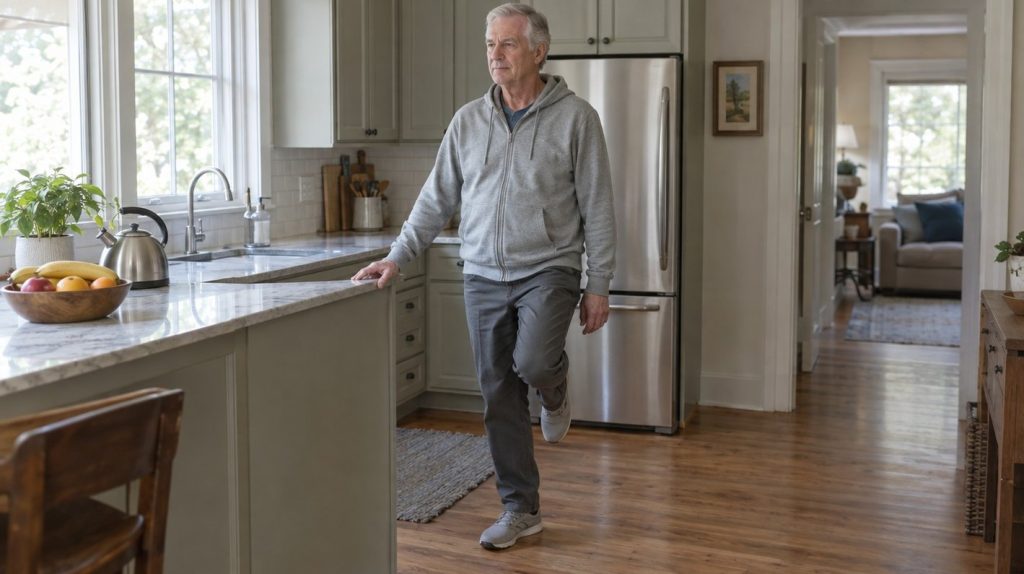
Stand at your kitchen counter, rest one hand on it, and lift one foot a few inches off the floor.
If your standing leg wobbles or your hand tightens on the counter edge, you have found the thing worth training. A short home routine of seven moves, done about three times a week, can help train your balance.
This is general information, not medical advice. If you feel dizzy or the room spins, go straight to the last section.
What the research says about balance work
The National Institute on Aging, the part of the National Institutes of Health that studies aging, lists balance as one of three types of exercise, beside aerobic and muscle-strengthening. Its guidance says balance exercises help prevent falls and fall-related injuries.
A 2019 Cochrane review of exercise for preventing falls pooled 108 trials with 23,407 people living at home. Their average age was 76.
- Any kind of exercise in the trials lowered the fall rate by 23 percent.
- Balance and functional exercises cut it by 24 percent.
- The reviewers were uncertain about programs that were mainly walking.
The clear effect came from balance and functional exercises, while the effect of walking programs was uncertain.
Those trials tested whole programs, not this exact routine. Most had unclear or high risk of bias, so read the numbers as a direction, not a promise.
The routine, step by step
This page puts them in an order that moves from two feet, to one foot, to a narrow line.
Every row follows the National Institute on Aging’s exercise guide, as printed on a balance exercise sheet from Northwell. The guide gives no count for rows 1, 6 and 7.
| Exercise | How | Hold and reps |
|---|---|---|
| 1. Sit to stand | Stand up from a sturdy chair and sit back down without using your hands. | No count given |
| 2. Tiptoe stand | Hold a table or chair. Rise slowly onto your toes as high as you can, then lower your heels all the way. | Hold 1 second. 8 to 15 reps, rest, one more set |
| 3. Knee curl | Hold a chair. Bend one knee so the foot lifts behind you, lower it, then switch legs. | Hold 1 second. 8 to 15 per leg, rest, one more set |
| 4. Back leg raise | Stand 12 to 18 inches from a chair and bend forward at the hips, about 45 degrees. Lift one leg straight back without bending the knee. | Hold 1 second. 8 to 15 per leg, rest, one more set |
| 5. Side leg raise | Stand directly behind a chair, feet slightly apart. Lift one leg 6 to 12 inches out to the side, toes forward. | Hold 1 second. 8 to 15 per leg, rest, one more set |
| 6. One-foot stand | Hold a chair and stand on one foot, then alternate feet. | No count given |
| 7. Heel-to-toe walk | Put your heel just in front of the toes of the other foot each step, so they touch or almost touch. | No count given |
Lower each leg slowly and pause between reps. The guide says to lower the foot or heel all the way down, then pause, before the next one.
Make each move harder, one step at a time
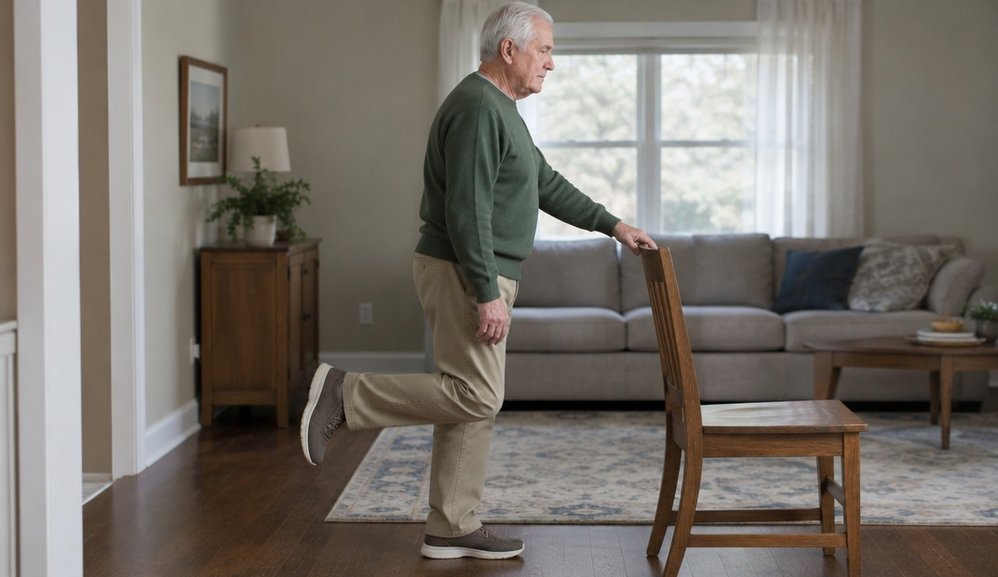
For moves 2 to 5, the guide describes the next steps in order:
- Hold a sturdy table or chair.
- When you are able, hold with only one hand.
- With time, hold with one fingertip.
- Then hold with no hands at all.
Only if you are really steady on your feet, the same sheet adds, try the move with your eyes closed.
The challenge you add is less support, not more speed. Moving a step down the list is the progress.
Set up the space and the schedule
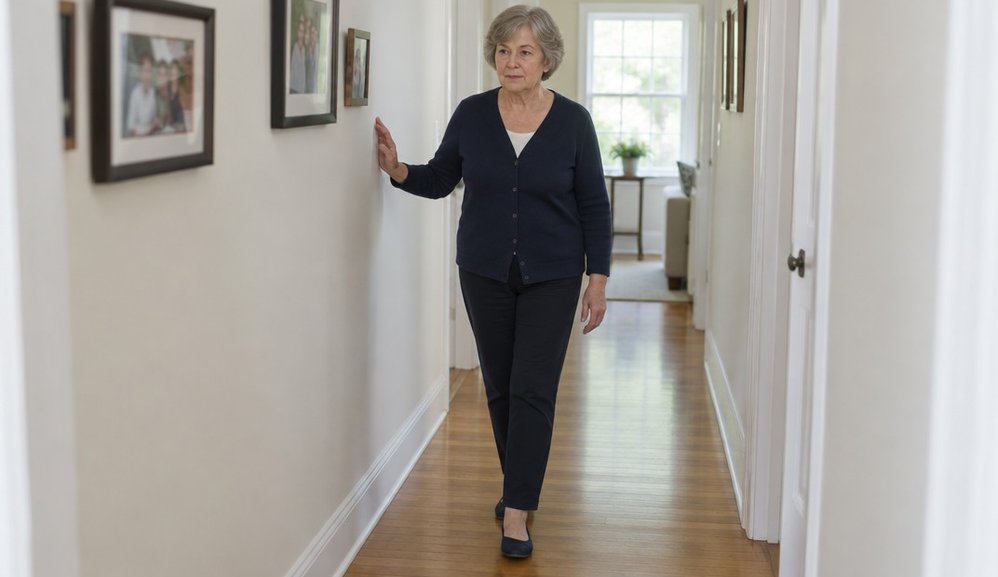
- Keep a sturdy chair, a wall or another person within reach.
- Go slowly and mindfully, and steady yourself if you feel unsteady.
- Wear comfortable, stable shoes, or go barefoot for grip on the floor.
- If you are unsure about a move, ask your doctor or physical therapist.
For the heel-to-toe walk, a hallway works because the wall is within reach. If worry about falling is what keeps you from trying any of this, the fear of falling is worth reading first.
Aim for about three sessions a week. That is the National Institute on Aging’s figure for balance exercises.
The Otago Exercise Programme shows what a full program looks like. New Zealand researchers designed it as a home-based strength and balance program.
It is done three times a week for 30 minutes. In the original program, a physical therapist makes five home visits over six months.
This routine is not that program.
How to tell it is working
Your first sign is on the list above.
If a move needed two hands last month and one fingertip now, it is working.
For a second check, use the 30-second chair stand.
Write the number down before you start the routine. Your own earlier number is the one to beat.
Stop the test and the routine if a knee or hip is painful or if you feel dizzy. Treat sharp, new or one-sided pain as a reason to stop.
When to ask for a balance assessment
Feeling unsteady, dizzy or as if the room is spinning is a reason to talk with your doctor. So is losing your balance or falling, says the National Institute on Aging.
It adds that a physical therapist can develop exercises for one person’s balance problem.
Ask your doctor or a physical therapist for a balance assessment, rather than going it alone, if any of those describes you.