

If your cane goes with you on outdoor walks, choose it by the ground: pavement, gravel or an easy trail.
For walks that leave the sidewalk, start with the HurryCane Freedom Edition. HurryCane lists a pivoting three-point base and says the cane stands up on its own.
Some links here go to Amazon, and WoodsWalk earns a small commission if you buy through them, at no extra cost to you.
The four canes and the walk each one suits:
- HurryCane Freedom Edition: pivoting three-point base, folds, stands on its own. The pick for gravel and easy trails.
- Vive Folding Cane: the light folding cane for the bag, rated to 250 pounds, takes ice and quad tips.
- NOVA Sugarcane offset quad cane: the widest base and the widest height range here, rated to 300 pounds.
- Carex Soft Grip derby cane: the plain single-tip cane for pavement, with a soft derby handle.
HurryCane Freedom Edition
Sidewalks that turn into gravel, packed dirt and easy trails.
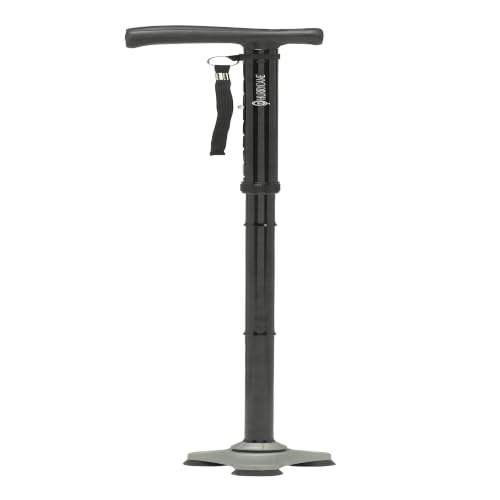 HurryCane Freedom Edition folding cane
Pivoting three-point base, 4.25 inch footprint
Adjusts 30.5 to 37.5 inches, folds to 13.7 inches
Look up your size and the price on Amazon
HurryCane Freedom Edition folding cane
Pivoting three-point base, 4.25 inch footprint
Adjusts 30.5 to 37.5 inches, folds to 13.7 inches
Look up your size and the price on Amazon
HurryCane lists a pivoting design at the three-point base. A pivot lets the base stay flat while the shaft leans, as it does on a slope or a cambered path.
The base is bulkier at the ankle than a single tip, and HurryCane sells its own replacement feet for it. The listing gives no weight limit.
- Made for
- A park bench with nowhere to lean it: HurryCane says it stands on its own
- Unsuited to
- Pavement-only walks, where the pivot has less to do (that is the Carex)
Vive Folding Cane
Walks that only sometimes need a cane, with the cane folded in a bag.
 Vive folding cane, adjustable
Rated to 250 pounds, 33 to 37 inches in 1-inch steps
Folds at three points, takes quad and ice tips
Look up your size and the price on Amazon
Vive folding cane, adjustable
Rated to 250 pounds, 33 to 37 inches in 1-inch steps
Folds at three points, takes quad and ice tips
Look up your size and the price on Amazon
Vive lists an aluminum frame that folds at three points, and its own product page puts the weight at 8 ounces. That makes it easy to carry on a walk where you may not need it.
A folding shaft has joints that a one-piece cane does not.
- Made for
- Ice in winter: Vive says the tip swaps for tripod, quad and ice tips
- Unsuited to
- Shorter walkers: at 33 inches, its lowest setting is the highest of the four canes here
NOVA Sugarcane offset quad cane
Walks where the cane is on the ground at every step, with the widest base here.
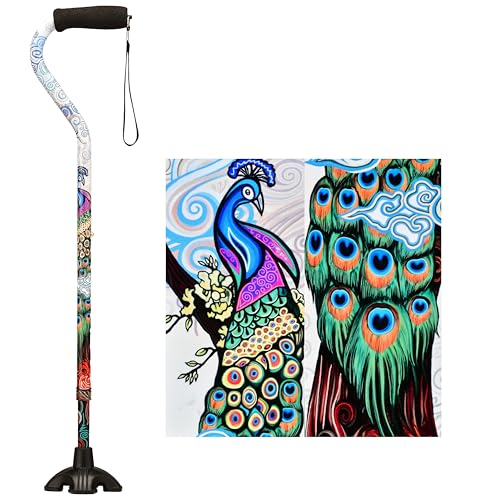 NOVA Sugarcane offset quad cane
Stands on its own, 4.75 inch quad base, 300 pounds
Adjusts 28 to 39 inches, listed at 1.15 pounds
Look up your size and the price on Amazon
NOVA Sugarcane offset quad cane
Stands on its own, 4.75 inch quad base, 300 pounds
Adjusts 28 to 39 inches, listed at 1.15 pounds
Look up your size and the price on Amazon
Of the four canes, the NOVA covers the widest height range, and it is the only one listed above 250 pounds. The offset handle puts your hand over the shaft rather than beside it.
A rigid quad base has to land fairly flat, where the HurryCane’s base pivots.
- Made for
- Users from 4 feet 11 to 6 feet 4, the span NOVA lists
- Unsuited to
- A cane that rides in a bag: it does not fold (that is the Vive)
Carex Soft Grip derby cane
Pavement and dry park paths, with a plain cane that does not draw attention.
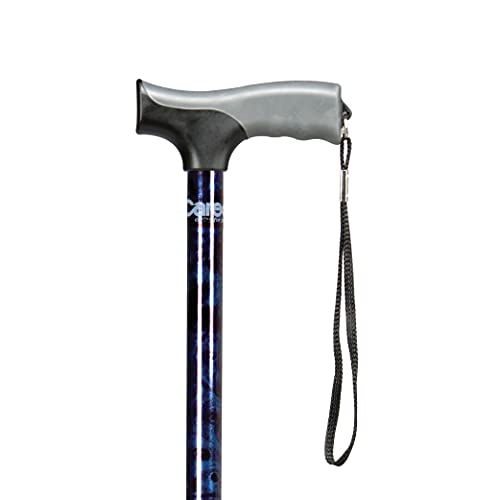 Carex Soft Grip derby walking cane
Soft-grip derby handle, latex free, 250 pounds
Push-button height, anti-slip rubber tip, wrist strap
Look up your size and the price on Amazon
Carex Soft Grip derby walking cane
Soft-grip derby handle, latex free, 250 pounds
Push-button height, anti-slip rubber tip, wrist strap
Look up your size and the price on Amazon
Carex says the soft, latex-free grip is built to reduce shock through the hand. A derby handle is the classic shape, a short crook that sits across the palm.
Carex’s own site lists a 31 to 40 inch height range and a cane weight of 0.74 pounds.
- Made for
- Either hand: Carex says the handle suits both
- Unsuited to
- Rooted or stony ground, where a single tip has no wide base (that is the HurryCane)
The Brazos twisted oak is a stick, not a cane
Some readers searching for a cane really want a walking stick for the trail, and the maker’s listing is clear about the difference.
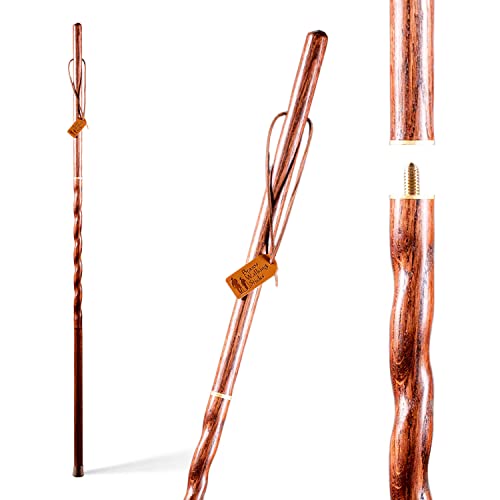 Brazos twisted oak traveler walking stick
55 inch hardwood stick, breaks down into three pieces
For balance on trails, not for carrying full body weight
Look up your size and the price on Amazon
Brazos twisted oak traveler walking stick
55 inch hardwood stick, breaks down into three pieces
For balance on trails, not for carrying full body weight
Look up your size and the price on Amazon
Brazos lists a 55 inch stick in solid twisted oak, handcrafted in the USA, that breaks into three pieces for travel.
Brazos states plainly that it helps with stability on the trail and is not intended to support full body weight. If a hip or knee needs weight taken off it, you want one of the four canes above.
Brazos gives a sizing guide by height, and a stick does not adjust:
- Under 4 feet 5: the 41 inch stick.
- 4 feet 5 to 5 feet 4: the 48 inch stick.
- 5 feet 4 to 5 feet 11: the 55 inch stick.
- Over 5 feet 11: the 58 inch stick.
What a review for family doctors says about canes
Most people using a cane or walker have never been shown how to use it, a 2011 review found. Many had a device that was damaged, unsuitable or the wrong height.
The review appeared in American Family Physician, the journal of the American Academy of Family Physicians.
It sets the height: the top of the cane should reach the crease of your wrist when you stand upright with your arms relaxed.
The review puts the cane on the side away from the leg that is weak or painful.
A cane can take some weight off a weak or painful leg, the review says. It can also widen your base of support and let your hand feel the ground.
It is a review of guidance, not a test of these four canes, so it says nothing about which of them suits you.
How to choose between them

Once you know the kind of cane you need, three numbers narrow the choice: the base, the height range and the weight limit.
| Cane | Base and folding | Height range and weight limit |
|---|---|---|
| HurryCane Freedom Edition | Pivoting three-point, 4.25 in; folds | 30.5–37.5 in; limit not listed |
| Vive Folding Cane | Single rubber tip, swaps for quad or ice; folds | 33–37 in; 250 lb |
| NOVA Sugarcane | Rigid quad, 4.75 in; does not fold | 28–39 in; 300 lb |
| Carex Soft Grip derby | Single rubber tip; does not fold | 31–40 in; 250 lb |
If your wrist-crease height falls outside a cane’s range, or your weight is above its limit, it is not the cane for you.
Worth paying for
- A base that stands by itself, if there is nowhere to lean the cane when you stop. The HurryCane and the NOVA both do.
- A tip that swaps for an ice tip in winter, if you keep walking when the paths freeze.
Not worth paying for
- A wrist strap on its own. The Vive, NOVA and Carex all come with one.
Which cane to take out the door

| Your walk | Take a look |
|---|---|
| Gravel, packed dirt and easy trails | HurryCane Freedom Edition |
| A cane you only need some of the time | Vive Folding Cane |
| The cane on the ground at every step | NOVA Sugarcane offset quad cane |
| Pavement and park paths | Carex Soft Grip derby cane |
The stair order and the walking rhythm are in how to walk with a cane. For the first rooted path, how to stay steady on uneven trails covers footing and stride.
Check with your doctor or physical therapist before you rely on a cane after a fall or a new pain.
If the cane you own reaches your wrist crease, is undamaged and still has tread on the tip, it may not need replacing. If only the tip is worn, a fresh rubber tip is the fix.
If both legs are fine and it is your balance on uneven ground that worries you, walking poles are worth asking your physical therapist about.
If you lean on a cane hard on every step, you may be asking more of it than a cane is built for.
A walker is built to take your weight, the review notes, and that is a conversation for your doctor or physical therapist.