

In winter, one town sidewalk can hold packed snow, slush, ice and bare concrete within a single block.
For most town walks on packed snow, start with the Yaktrax Walk. Under its earlier name, Yaktrax Walker, it was tested in a trial published in 2005.
In that trial, fall-prone walkers aged 65 and over were given it or kept their usual winter footwear. Those given it fell outdoors less than half as often on days with snow and ice.
If your route is mostly bare concrete and ice, the Diamond Grip lists both.
WoodsWalk may earn a commission when you buy through the Amazon links on this page, and the price you pay stays the same.
The five pairs and the walk each one suits:
- Yaktrax Walk is the pick for most walks. Yaktrax lists its thin steel coils and heel tab for packed snow and slush in town.
- Yaktrax Diamond Grip has swiveling steel beads, listed for ice and pavement as well as snow.
- Yaktrax Pro has thicker coils and a removable strap over the foot. Its terrain list includes pavement.
- STABILicers Walk has steel plates under the heel and forefoot, for the driveway and the dog.
- Kahtoola EXOspikes have 12 carbide-tipped spikes per foot, for frozen park paths and easy winter trails.
Yaktrax Walk
Packed snow on errands and dog walks around town.
 Yaktrax Walk Traction Cleats
1.2 mm high-strength steel coils
Elastic band with a heel tab
Look up your size and the price on Amazon
Yaktrax Walk Traction Cleats
1.2 mm high-strength steel coils
Elastic band with a heel tab
Look up your size and the price on Amazon
Under its earlier name, the Yaktrax Walker, it was the model tested in a falls trial published in 2005. The walkers were aged 65 and over and prone to falls, through a winter in the northern United States.
You pull the band up over your heel by the tab, rather than stretching the band with both hands.
- Made for
- Pulling on with cold fingers: a heel tab at the back of the band
- Also think about
- The Diamond Grip, if much of your route is bare pavement
Yaktrax Diamond Grip
Town sidewalks where ice, slush and bare concrete change within one block.
 Yaktrax Diamond Grip Traction Cleats
Case-hardened steel beads on steel aircraft cable
Natural rubber sling, sizes S to 2XL
Look up your size and the price on Amazon
Yaktrax Diamond Grip Traction Cleats
Case-hardened steel beads on steel aircraft cable
Natural rubber sling, sizes S to 2XL
Look up your size and the price on Amazon
Instead of coils, Yaktrax strings steel beads on cable, and it lists this pair for ice and pavement. The Walk’s list has neither, which makes this the pick when bare concrete fills much of your route.
Yaktrax says the swiveling beads keep snow and ice from building up as you move between gravel, dirt and concrete.
- Made for
- Winter boots as well as shoes: Yaktrax sizes it for insulated footwear too
Yaktrax Pro
Town walks where you want the cleat held firmly in place on your boot.
 Yaktrax Pro Traction Cleats
1.4 mm steel coils, tested to -41°F
Removable strap over the foot, heel tab
Look up your size and the price on Amazon
Yaktrax Pro Traction Cleats
1.4 mm steel coils, tested to -41°F
Removable strap over the foot, heel tab
Look up your size and the price on Amazon
The Pro keeps the Walk’s coil design on a heavy-duty natural rubber frame. Its coils are 1.4 mm thick against the Walk’s 1.2 mm. A removable strap crosses the top of your foot to hold the cleat in line.
For oversized shoes and boots, Yaktrax advises ordering one size up.
- Made for
- Packed snow and pavement, both on Yaktrax's list for it (the Walk's list has no pavement)
- Also think about
- The Walk, if you do not need the strap
STABILicers Walk
Everyday jobs just outside the door: the driveway and the dog.
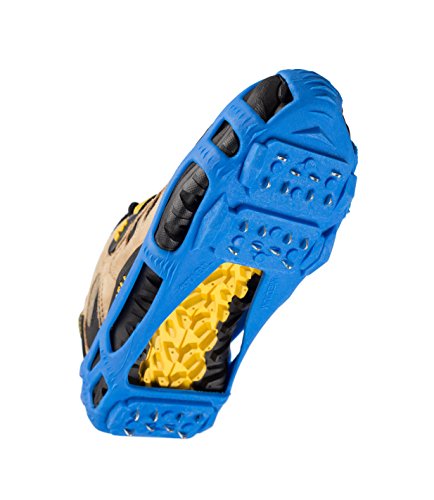 STABILicers Walk Traction Cleats
Heat-treated steel plates at heel and forefoot
Stretch-to-fit binding, flexible to -45°F
Look up your size and the price on Amazon
STABILicers Walk Traction Cleats
Heat-treated steel plates at heel and forefoot
Stretch-to-fit binding, flexible to -45°F
Look up your size and the price on Amazon
Instead of coils or beads, it has steel plates molded into the heel and forefoot, and the binding covers the whole sole. STABILicers names walking the dog and shoveling the driveway as the jobs it is built for.
The listing gives no shoe-size ranges in its description. Check the size options on the page against your winter boots before you order.
- Also think about
- The Diamond Grip, if your walk goes on past the driveway to icy town sidewalks
Kahtoola EXOspikes
Frozen park paths and easy winter trails, away from the pavement.
 Kahtoola EXOspikes Footwear Traction
12 spikes per foot with tungsten carbide tips
Stretchy harness to -22°F, 4-year warranty
Look up your size and the price on Amazon
Kahtoola EXOspikes Footwear Traction
12 spikes per foot with tungsten carbide tips
Stretchy harness to -22°F, 4-year warranty
Look up your size and the price on Amazon
It is the only pair here with spikes rather than coils, beads or plates. Kahtoola lists frozen trails and icy roads among the ground it is made for, and says the open design sheds snow quickly.
- Made for
- Hiking shoes and boots, the footwear Kahtoola writes it for
- Unsuited to
- Town sidewalks only: Kahtoola designs it for hiking and trail running
What a winter trial with older walkers found
In the 2005 trial, walkers given the Yaktrax Walker fell outdoors less than half as often on days with snow and ice.
It followed 109 people aged 65 and over through a winter in the northern United States, all prone to falls.
They were assigned at random to wear the device outdoors or to keep their usual winter footwear. Each kept a daily diary of slips and falls.
Falls that caused a minor injury ran at about one-eighth of the other group’s rate, per day walked on snow and ice. No fall in either group caused a serious injury or a fracture.
The results were published in the Journal of the American Geriatrics Society.
Twelve of the device group’s 19 outdoor falls happened while they were not wearing it. Put them on at the door, not at the first glazed patch where a gutter drips.
The trial covered one winter, one device and about a hundred people with a history of falls. It says nothing about how the other four pairs here compare.
Coils, beads, plates or spikes
Each pair grips with one of four things, and each maker lists the ground it is for:
- Coils (Yaktrax Walk and Pro): steel coils on an elastic band. Yaktrax lists the Walk for packed snow, slush and mixed conditions, and adds pavement for the Pro.
- Beads (Yaktrax Diamond Grip): steel beads strung on cable, listed for ice and pavement as well as packed snow and slush.
- Plates (STABILicers Walk): steel plates at the heel and forefoot, for snow and ice on jobs around the house.
- Spikes (Kahtoola EXOspikes): carbide-tipped spikes for frozen trails and icy roads.
If much of your route is bare pavement between icy patches, choose a pair whose maker lists pavement: the Pro or the Diamond Grip.
Worth paying for
- A heel tab, if cold fingers make stretching the band hard. The Walk and the Pro both have one.
- A strap over the foot, if you want the cleat held firmly in place. Of these five, only the Pro lists one.
Not worth paying for
- Trail spikes, if you never leave the sidewalk. Kahtoola builds the EXOspikes for hiking and trail running.
- Any cleats for a route that is plowed and salted every morning. They are made for snow and ice, and there will be little of either to grip.
Putting them on, and taking them off at the door
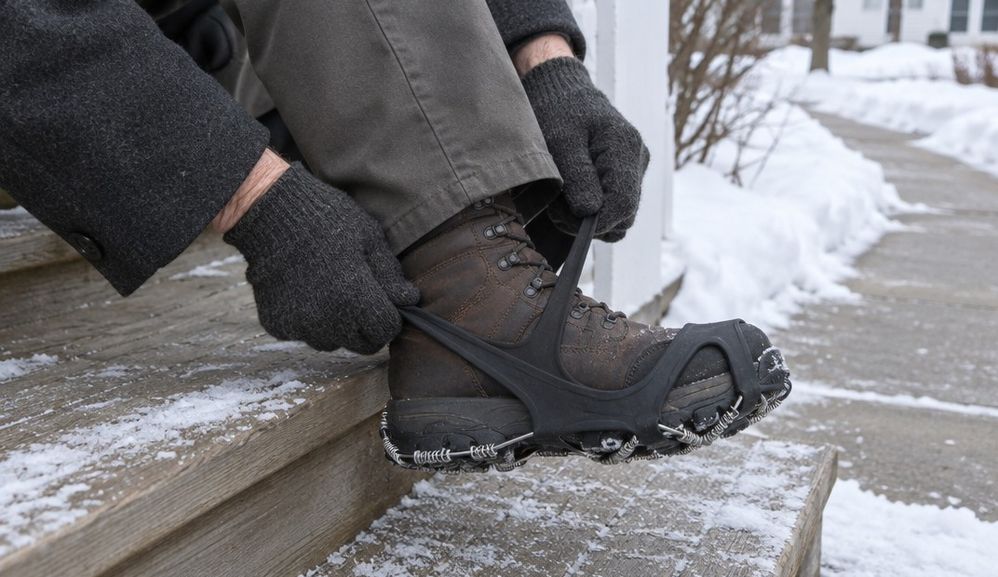
Sit down on a step or a bench. Hook the front of the cleat over your toe, then stretch the back up over your heel.
Take them off before you step inside. Winter Walking, a company that makes ice cleats, warns that most cleats become “an extreme slip hazard” on tile, linoleum and sealed concrete.
Keep a plastic bag in your coat pocket, so you can carry them into a store without dripping.
Which pair to keep by the door
| Your walk | Take a look |
|---|---|
| Packed snow on most town walks | Yaktrax Walk |
| Long stretches of bare pavement and ice | Yaktrax Diamond Grip |
| A strap to hold the cleat on your boot | Yaktrax Pro |
| The driveway and the dog | STABILicers Walk |
| Frozen park paths and easy trails | Kahtoola EXOspikes |
Each pair comes in sizes. Order the size for the boots you will wear them over, and check the size options on its listing.
If a recent fall, dizziness or a new pain is why you want cleats, talk to your doctor first.
If the cold rather than the ice keeps you indoors, dressing in three layers is the place to start.
You may not need cleats at all if your route is cleared and salted, or if you can move the worst mornings indoors. A mall loop still counts as a walk.