
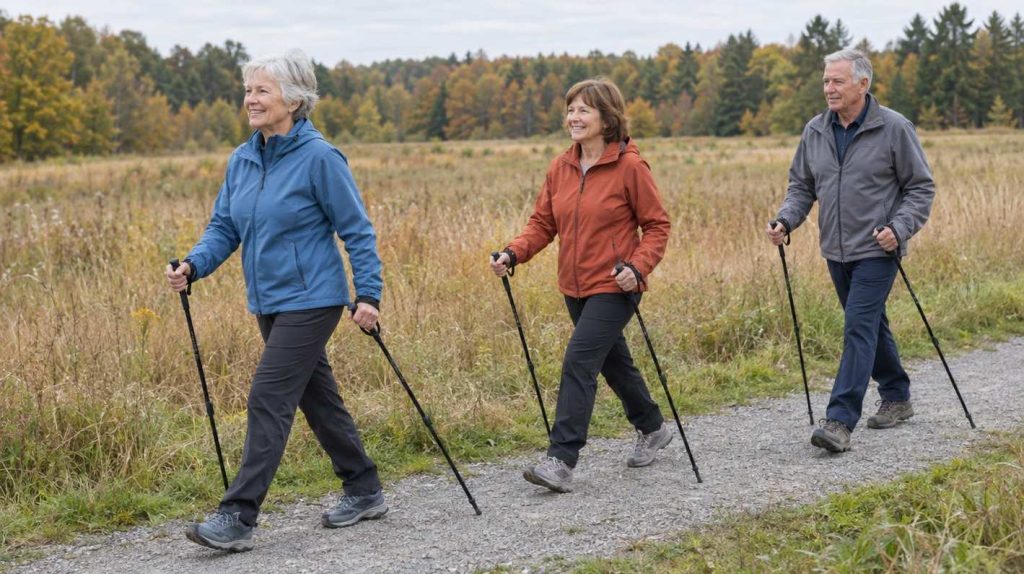
Nordic walking is ordinary walking with two poles, each pushed back behind you as you stride, so your arms do work too.
It is worth learning if you want more from the same walk. A review of studies in adults aged 60 to 92 found gains in fitness, strength and balance while moving.
This is information, not medical advice. If you have a heart condition, or a joint that hurts in a sharp or new way, ask your doctor first.
What the research found for older adults
Bullo and colleagues pooled 15 studies of adults aged 60 to 92, in a 2018 review in Rejuvenation Research (a peer-reviewed medical journal). Compared with groups that stayed sedentary, Nordic walking improved:
- Aerobic capacity (0.92)
- Upper-limb strength (0.66)
- Functional balance (0.62)
- Lower-limb strength (0.43)
- Dynamic balance (0.30)
These are effect sizes, a standard measure where a bigger number means a bigger difference between groups.
Against plain walking, poles also added gains. Dynamic balance came out at 0.30, lower-body flexibility at 0.47 and quality of life at 0.53.
An earlier review by Tschentscher and colleagues, in the American Journal of Preventive Medicine in 2013, covered 16 randomized trials and 11 observational studies.
The trials had 1,062 people and the observational studies 831. Nordic walking beat brisk walking without poles on heart rate, oxygen use and quality of life.
In some measures it also beat jogging. The groups included people with various diseases.
The first set of figures compares Nordic walking with doing no exercise.
The technique in five steps
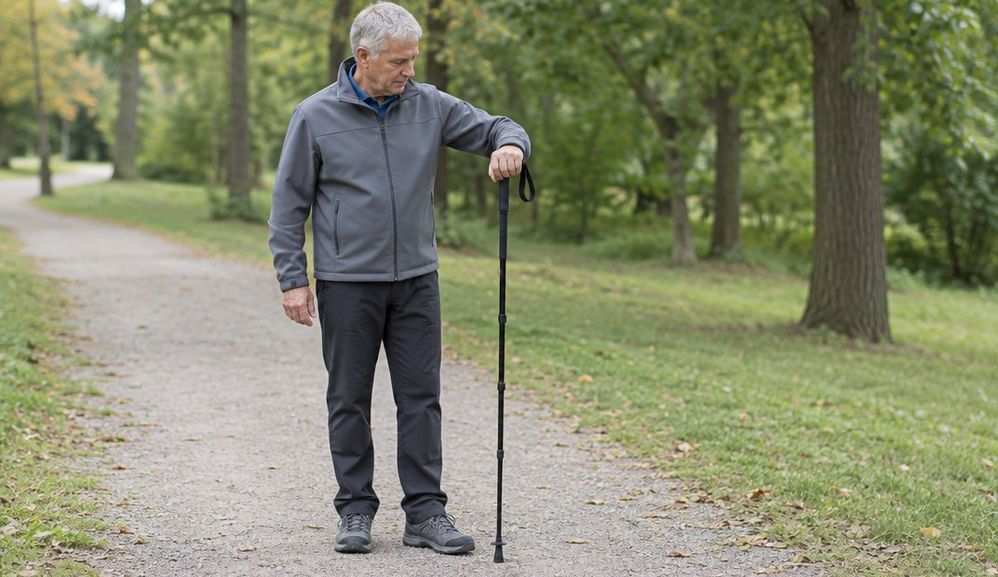
- Set the pole length. Hold your forearm out at a right angle to your body. Your palm should cover the top of the pole. So says Harvard Health Publishing, Harvard Medical School’s consumer health publisher. Kaunas University of Technology in Lithuania gives a formula: your height in centimeters times 0.68.
- Plant the pole at an angle. Leki, a maker of walking poles, says the pole goes down angled toward the back, not vertical.
- Push down and back. The International Nordic Walking Federation is a non-profit founded in Finland in 2000. It says pushing down and back through the poles pulls the body forwards and up. Grip firmly as the pole plants, then open your hand fully on the follow-through, as Leki describes.
- Swing the opposite arm. The right arm goes forward with the left leg, and the left arm with the right leg. Keep your normal stride, landing heel first and rolling through the foot.
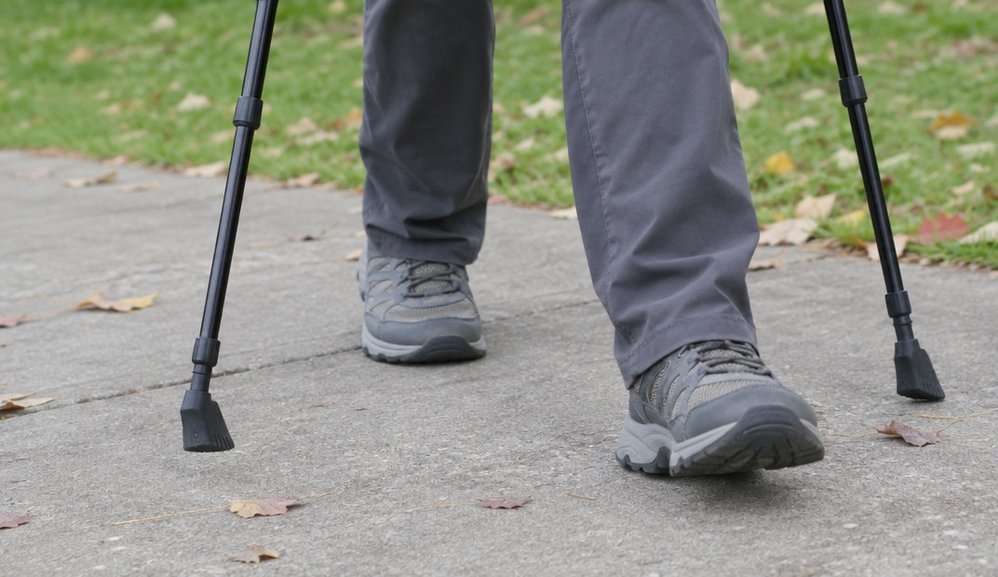
- Use rubber tips on sidewalks. Harvard Health notes that poles come with pointed tips for trails and rubber tips for sidewalks.
With the pole angled back, your arms help push you forward. That is what separates this from carrying poles along.
How it differs from trekking with poles
Trekking and hiking poles have loose wrist straps. Most Nordic poles carry a glove-like strap system instead, says Harvard Health, and you slide your hand into it.
Nordic walking angles the pole back and drives it behind you on every stride.
If you mainly want poles for steep or loose ground, whether you need walking poles at all depends on your knees, your balance and where you walk.
Three beginner trekking poles differ in lock, grip, anti-shock and travel size.
Who gains most
Harvard Health describes Nordic walking as particularly helpful for older adults. It says it can help improve mobility and balance.
The force of each stride is spread through the poles, and so less of it goes through the legs.
The clearest fits are walkers who want more fitness and strength, and walkers who want steadier balance while moving.
If a joint hurts in a sharp or new way, stop and ask your doctor. For balance work away from the trail, a short home balance routine covers seven moves.
Your first four sessions
If you normally walk 20 to 30 minutes, Harvard Health suggests using the poles for about a quarter of the walk at first.
Harvard Health advises beginning with single poling, one pole planted for each stride, and building speed and arm swing gradually.
- Session one: single poling, one pole planted for each stride, natural steps, conversational pace.
- Session two: the same pace, now swinging the opposite arm with each leg.
- Session three: add the push, down and back, with the open hand on the follow-through.
- Session four: let the arm swing grow a little and the pace rise slightly.
Leki puts the pace limit simply: if your breathing becomes irregular, you are probably moving too quickly.
The first session with the poles
Start short: poles for about a quarter of a normal walk.
Before you leave, set each pole with the forearm test. Fit the rubber tips if you will walk on sidewalks.
Then walk at a pace where you could hold a conversation. Plant one pole for each stride, as in single poling, and keep your usual steps.
Use the poles for about a quarter of your usual walk, then finish the walk without them.