
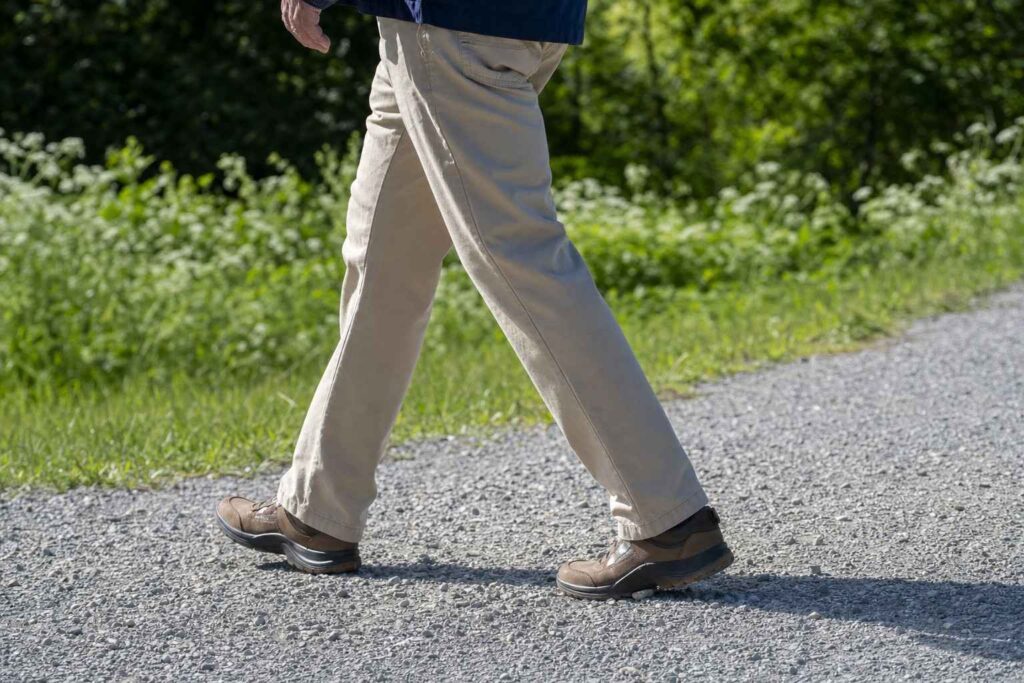
You feel it on the stairs, or getting out of the car. A small twinge in the knee. And a worry follows close behind it.
If walking already pulls a little, surely all those steps are wearing the joint down faster. Using it up, like tread on a tire.
It is one of the most common fears people carry into their fifties and sixties.
For most people, ordinary walking does not wear out the knees.
The research points the other way, and so does the way the joint is actually built. That surprises almost everyone who asks.
What the Research Actually Found

Some of the most useful evidence comes from a long-running study of older knees.
Researchers drew on the Osteoarthritis Initiative, a community study that has followed thousands of adults for years.
In an analysis published in the journal Arthritis & Rheumatology, they looked at people aged 50 and older who already had knee osteoarthritis. Then they asked a plain question.
Did the ones who walked for exercise fare better, or worse?
The walkers were less likely to develop new, frequent knee pain.
Compared with those who did not walk for exercise, the walkers had about 40% lower odds of new frequent knee pain over the follow-up.
These were people who already had arthritis in the knee, the very group most afraid of doing harm.
The people most worried about walking were the ones it seemed to help.
One honest note belongs here.
This was an observational study, not a controlled trial. It shows an association, not proof.
The researchers raised the obvious worry themselves. Perhaps people walked more simply because their knees hurt less to begin with.
They checked across age groups and the link held, but it is still a link, not a promise for any one person.
The same study also looked at whether walking slowed the joint’s decline on x-ray. That signal leaned the same hopeful way, but it was weaker and did not reach statistical significance.
The clear, repeated finding was about pain, not cartilage measured on a scan.
Why Movement Feeds the Knee
The fear pictures the knee as a machine part that grinds down with use. The joint does not work that way.
Cartilage, the smooth surface that lets the knee glide, has no blood supply of its own. It is fed a different way.
Joint cartilage is nourished by movement, not destroyed by it.
As the Arthritis Foundation explains, the cartilage in your joints draws its nutrition from the fluid that circulates as you move.
Each step gently presses the joint and pushes that fluid through it, the way a sponge soaks and releases. Sit still all day and the flow slows.
Move, and the joint is fed and stays lubricated.
A knee is not a tire. It is a living joint that needs to be used.
The benefits stack up quietly:
- Walking pushes nourishing fluid through the cartilage.
- It keeps the joint lubricated and the surrounding muscles working.
- Stronger muscles around the knee take load off the joint itself.
This is why “rest it completely” is rarely the whole answer for an everyday achy knee. Gentle, regular movement is usually part of the fix, not the threat.
What About Walking With Arthritis?

Having knee arthritis is a reason to walk wisely, not a reason to stop.
The picture is kinder than the fear, and it still has nuance. If you already have arthritis, how you walk matters as much as whether you walk:
- Shorter, more frequent walks often sit better than one long push.
- Softer ground, grass or a track, is easier on the joint than concrete.
- Supportive shoes that fit well take real strain off the knee.
There are sensible ways to adjust your walks when arthritis flares so you keep moving without paying for it the next day.
Strength around the joint is the quiet protector.
The muscles around a knee act like its shock absorbers. A few minutes of simple ankle and knee exercises build the support that makes each step easier on the joint.
And if you are walking back from surgery, the path looks different again, with specific guidance for returning to walking after a knee replacement.
You do not need special equipment to walk safely. A brace is not a requirement, and reaching for one “just in case” often does more for your worry than your knee.
If you already have arthritis and your doctor has suggested some support, it is worth knowing what to look for in a knee brace for walking rather than guessing in a shop aisle.
When a Knee Is Telling You to Stop
Reassurance is not the same as ignoring pain. There is a real line between the ordinary ache of a joint waking up and a signal you should respect.
Sharp, new, or one-sided pain means stop, not push through.
A few signs are worth taking seriously:
- A sharp or sudden pain, rather than a dull, familiar ache.
- Pain in only one knee that is new or getting worse.
- A knee that swells, locks, gives way, or will not bear weight.
Those are reasons to stop and check in with a doctor, not to walk further and hope. Most achy knees are not in that category. But you know your own, and the difference is worth respecting.
The Honest Bottom Line
So here is the picture:
Walking does not wear out a healthy knee, and for many sore knees it is part of what keeps them working.
The evidence is reassuring rather than absolute. It describes most people, not every person, and it cannot see your particular knee.
Even so, walking remains one of the best things you can do for the body after 50, knees included.
If a knee problem is ongoing, or a doctor has given you specific limits, follow those over any general article. This is information, not medical advice; your doctor knows your body.
For most of us, the worry is heavier than the risk.
The next easy walk is far more likely to help your knees than harm them.