
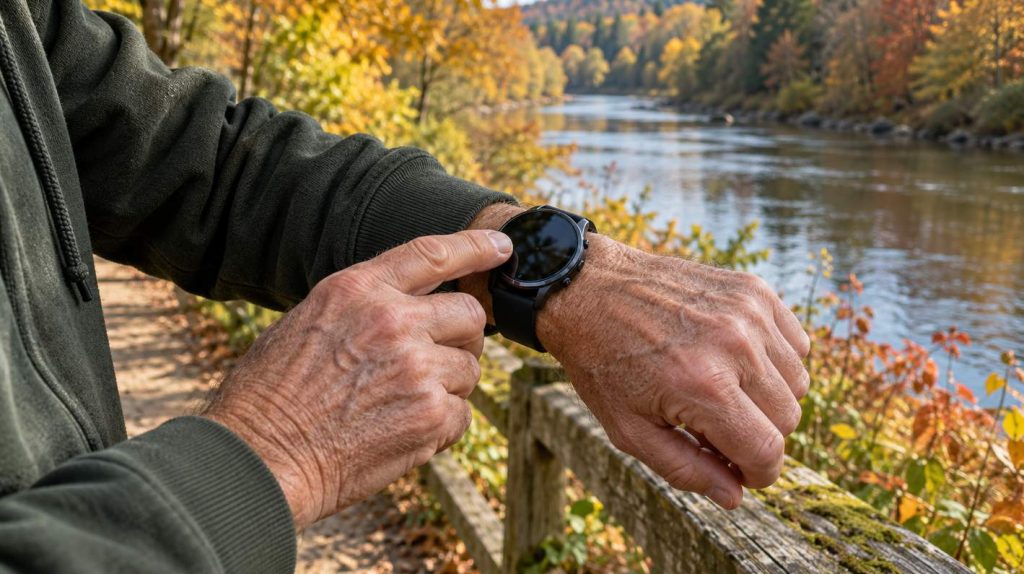
For a healthy adult, moderate walking effort is estimated at 50% to about 70% of maximum heart rate. For a healthy 60-year-old, that works out to about 83 to 116 beats per minute.
An age-based range is an estimate, not a personal limit. Your own maximum can differ from it, and some medicines change how your pulse responds.
What the age estimate says
According to Mayo Clinic, a US nonprofit medical center, the approximate maximum heart rate of healthy adults is 208 minus 0.7 times your age. It puts moderate intensity at 50% to about 70% of that maximum.
Here is the arithmetic for a healthy 60-year-old. It is a calculation, not a measurement of any real person.
- Estimated maximum: 208 − (0.7 × 60) = 166 beats per minute.
- Half of that: 83.
- Seventy percent: about 116.
So the estimated moderate range is roughly 83 to 116 beats per minute.
These are estimated exercise targets, not a diagnosis of your heart health. Being inside or outside the range does not, by itself, tell you whether something is wrong.
Mayo also points to perceived exertion, or a monitor, as ways to judge effort. It suggests new exercisers start light and build up gradually.
Checking effort without a monitor

According to the US Centers for Disease Control and Prevention (CDC), the federal public health agency, intensity is relative to fitness. A pace that is vigorous for one person can be moderate for a very fit one.
CDC rates effort on a scale from 0 (sitting) to 10 (maximum effort). Moderate effort is a 5 or 6. Vigorous starts at 7 or 8.
Its rule of thumb needs no device:
- Moderate: you can talk, but not sing.
- Vigorous: you can say only a few words before pausing for breath.
Say a friend is walking beside you and you are still telling them about your week. If you can talk comfortably but cannot sing, that matches CDC’s moderate description.
If you want to see how your pace relates to your health more broadly, walking speed as a signal of overall health is a separate measure with its own research.
When a beta blocker changes the picture
Take a different 60-year-old, one who takes a beta blocker. The usual target may not suit them, because the 166 and the 83 to 116 range above were worked out for healthy adults.
Mayo Clinic explains that beta blockers slow the heart and can prevent the usual rise in heart rate during exercise. You may not reach the usual target however hard you try, and exercise can still benefit your heart.
On a beta blocker, a low pulse does not mean your walk is too easy.
A clinician may suggest an exercise stress test to determine your target. An exertion scale is another way to judge effort, and your care team can help you choose and use one.
Most workouts should take effort while letting you keep going. If you can’t talk, you’re likely working too hard.
When to ask for a personal target

If you have a heart condition or take medicine that affects your pulse, ask your doctor before you set a pulse goal. The same goes if you can’t tell how hard to push.
A different style of walking, alternating easy and brisk stretches, is covered in interval walking, with its research and cautions.
Before your next appointment, write down two questions.
With my heart and my medicines, what effort should I aim for on a walk?
And should we set it with a rating scale or a stress test?