
Videos of people strolling backward promise sore knees that settle, steadier balance and a younger stride. Part of that holds up in small trials, and part of it does not.
Programs that included backward walking have helped some people with knee arthritis and some with shaky balance, but only in short, supervised trials.
This is general information, not medical advice. If you have dizziness, a recent fall or a knee that gives way, ask your doctor first.
What the knee trial found
Researchers at King Saud University in Saudi Arabia tested it on 68 adults with knee osteoarthritis, in the university’s outpatient physiotherapy department. Their average age was about 56, and the oldest was 66.
All of them did a routine physiotherapy program. Two groups added 10 minutes of supervised walking, three days a week for six weeks, either forward or backward.
Backward walkers’ pain fell from 5.7 to 3.9 on a 0 to 10 scale. The comparison group, with physiotherapy only, went from 5.8 to 4.8.
Knee function scores, thigh strength and a timed stand-up-and-walk test also beat the comparison group.
Backward walking did not beat forward walking in that trial. The gap between the two walking groups was not statistically significant on any measure.
No serious side effects were reported.
People with severe arthritis were left out, and the trial ran for six weeks only.
What the balance trial found
A trial in Iran enrolled 30 adults aged 61 to 82 and gave half of them treadmill training with a safety harness. Each scored 36 to 48 on a balance test, which points to some balance trouble.
Each session held 10 minutes of forward walking and 10 minutes of backward walking. The trained group came three times a week for four weeks.
Scores on that test, the Berg Balance Scale, rose from about 42 to 50. The comparison group stayed at about 43.
The distance covered in a six-minute walk also grew about 12 percent more than in the comparison group.
Backward walking was only half of that training, so it cannot take the credit alone. The forward half and the harness were part of the package.
Where to try it safely
The treadmill trial used a harness. A hallway or a kitchen does not come with one, so a firm hold has to stand in for it.
Pick a place where a hand can always touch something solid. Clear the floor of rugs, cords and shoes first.
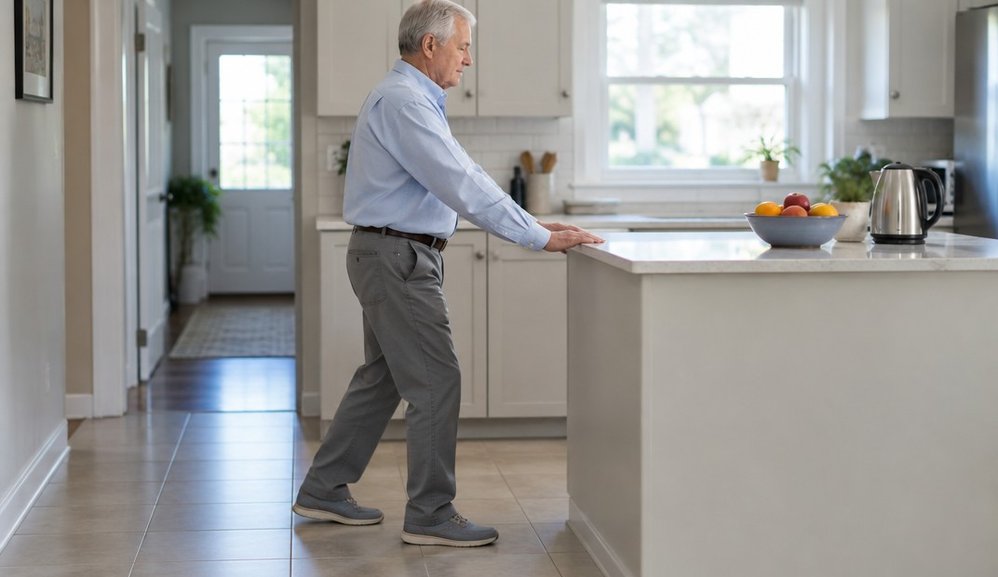
- A kitchen counter or a long wall rail suits the first tries.
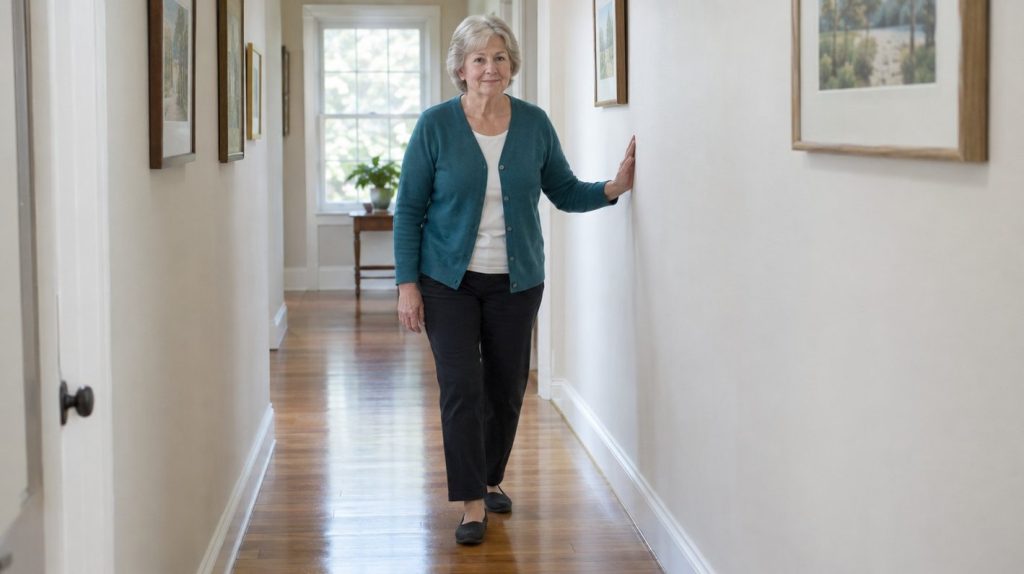
- A hallway with one hand on the wall comes next.
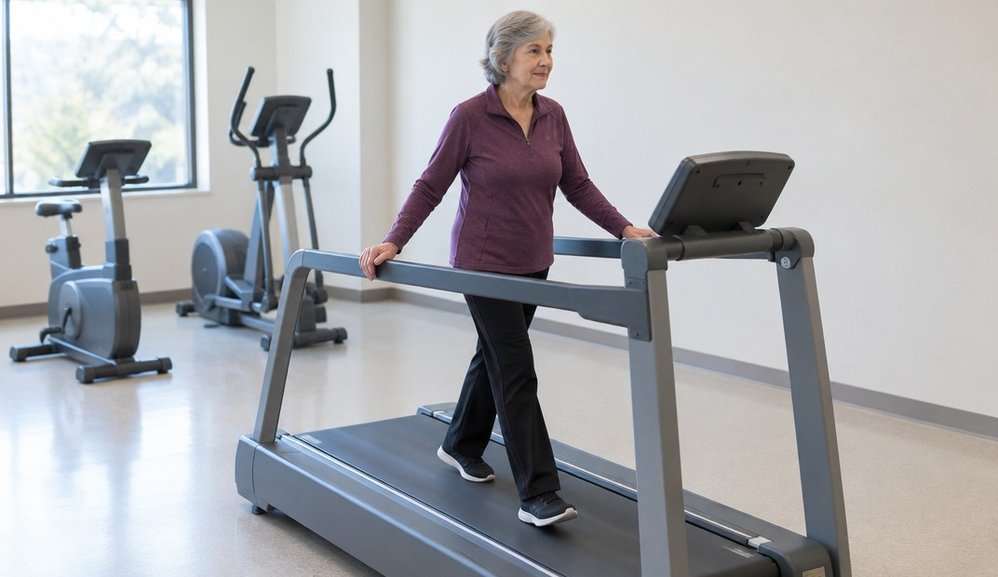
- A treadmill at its lowest speed is the last option, and only a treadmill with long handrails and a stop key qualifies.
Wear the flat shoes you already walk in.
Do not hold a phone, and do not step back toward stairs or a door sill.
Three steps from first try to a full set
Both trials worked in 10-minute blocks of walking.
At home, treat 10 minutes as something to build toward rather than where you start. Neither trial tested a home progression like this; it is a cautious way in.
- At the counter: hold on with both hands and go slowly for one minute.
- Along the hallway: keep one hand on the wall and go slowly for one minute.
- On the treadmill: start at the lowest speed, hold both rails and go for one minute.
Stop at once if you feel dizzy, if a knee pain turns sharp, or if the pain is new or only on one side.
Who should not try it
Skip it, or ask first, if balance or the knee is already unreliable. The knee trial excluded severe arthritis, and the balance trial excluded people with vertigo, joint replacements or walking aids, so neither says much about them.
That includes anyone recovering from a knee replacement, anyone who has fallen recently, and anyone with vision or dizziness problems. Ask your doctor or a physical therapist before trying it.
If the bigger question is whether walking wears out your knees, settle that before anything else. And if unsteadiness is the reason, a short balance routine at home is another place to begin.
How much, how often
The knee trial used 10 minutes, three days a week, with a warm-up and a cool-down on each day.
Backward steps add to your usual walk; they do not replace it.
Fit a few backward minutes into the end of that walk on two or three days a week. Leave the days in between free of it.
Move up from one step to the next only when you can finish a full minute at the current step with a light hold, no wobble, and no knee ache the next morning.