

Nobody has one normal mile time, because a normal pace shifts with age and sex.
For healthy walkers aged 50 to 69, the averages land between about 19 and 22 minutes.
Men’s averages run quicker than women’s in every decade, by about 2 minutes through the 70s. Both sexes slow to over 27 minutes in the 80s.
This is general information, not medical advice. A pace that slows suddenly with no obvious reason is worth mentioning to your doctor.
Typical mile times by age and sex
Researchers Bohannon and Andrews pooled 41 studies of 23,111 apparently healthy adults walking at a comfortable pace. A guide from the University of Toronto’s physical therapy department reproduced their speeds by decade.
The conversion is plain division. A mile is 1,609.34 meters.
For men aged 50 to 59 at 1.43 meters per second, 1,609.34 divided by 1.43 is about 1,125 seconds, or 18.8 minutes.
| Age | Men | Women |
|---|---|---|
| 50-59 | 18.8 min / 3.2 mph | 20.5 min / 2.9 mph |
| 60-69 | 20.0 min / 3.0 mph | 21.6 min / 2.8 mph |
| 70-79 | 21.3 min / 2.8 mph | 23.7 min / 2.5 mph |
| 80-99 | 27.7 min / 2.2 mph | 28.5 min / 2.1 mph |
These are average speeds from short courses, converted to a mile, not mile times anyone measured. The original walks ran 3 to 30 meters.
Healthy walkers land on both sides of an average.
How to time your own mile
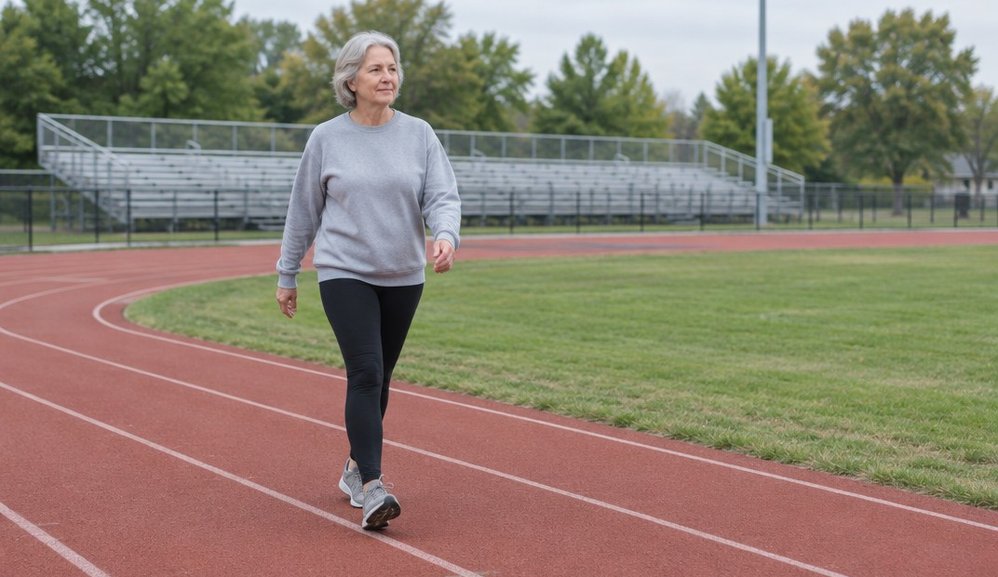
Pick a flat route you can walk without stopping. A phone map or a car’s trip meter will give you a measured mile.
- Walk at the pace that feels natural, not a pace you push.
- Start the timer once you are already moving.
- Avoid turns, crossings and hills where you can.
The pooled data came with a warning. Speeds measured over a short distance from a standing start, or with a turn, may not be a useful standard.
The table’s walks were short and straight, with no stops, turns or hills, so a real mile can come out slower.
From steps per minute to a mile time
A step counter can stand in for the stopwatch. In a study of 98 adults aged 61 to 85, 100 steps per minute matched about 3 METs, the energy cost of moderate activity.
That study does not give a step length, so measure yours. Walk 50 feet at your usual pace and count the steps. Say it takes 22.
- Steps per mile: 5,280 divided by 50 is 105.6, times 22 is about 2,320.
- At 100 steps per minute: 2,320 divided by 100 is 23.2 minutes.
- At 110 steps per minute: 2,320 divided by 110 is 21.1 minutes.
Steps per mile divided by steps per minute gives minutes per mile.
The 22 steps are an example, so use your own count.
If you wonder about the steps a 70-year-old might aim for each day, count steps over the whole day, not one walk.
What a slow time does and does not mean
A time slower than your row does not by itself mean something is wrong. The table shows averages for healthy adults, not a pass mark.
Fatigue, footwear and a hurried day all move a pace.
Researchers also study walking speed as a signal of overall health, which is a separate question from whether a mile time is typical.
The US Physical Activity Guidelines count brisk walking at 2.5 to 4.0 mph as moderate intensity. That equals 15 to 24 minutes per mile.
A 22-minute mile, about 2.7 mph, sits inside it.
How to get faster
Adults need at least 150 minutes of moderate activity each week, according to those guidelines.
A walk that reaches that range already counts, whether or not it beats the table’s average.
If you want a quicker mile, add a few brisker minutes inside a walk you already take. Then drop back to your usual pace.
Let pace build over weeks, not days. Add a little effort at a time, the same patience that goes into building distance gradually after 60.
Comfortable shoes you already own will usually do.
Say a 66-year-old woman times a flat mile at 24 minutes.
The table’s average for women aged 60 to 69 is 21.6 minutes, so she is about 2.4 minutes slower. Her 24 minutes works out to 2.5 mph, at the bottom edge of the moderate range.