
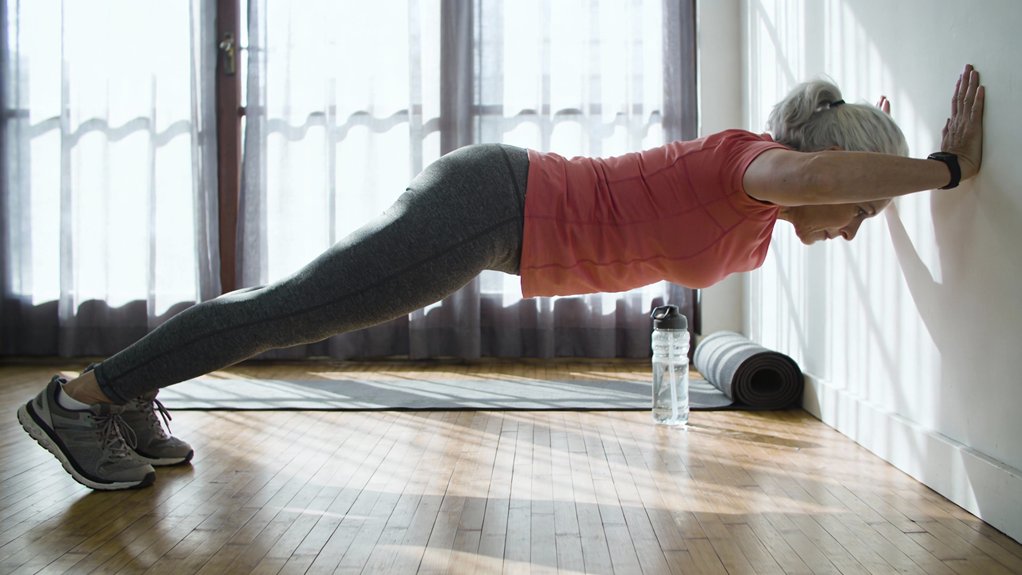
You’ve probably noticed that walking gets harder as you age, and there’s a simple reason: your muscles weaken faster than you think. After 50, you lose about 1-2% of muscle mass each year if you don’t actively work against it.
That’s where this 10-minute strength routine comes in. It targets the exact muscles you need for better balance, longer strides, and more power with each step. These moves are easier than they sound, and you can do them at home with little or no equipment.
The 6-Move Walking Strength Routine (10 Minutes)
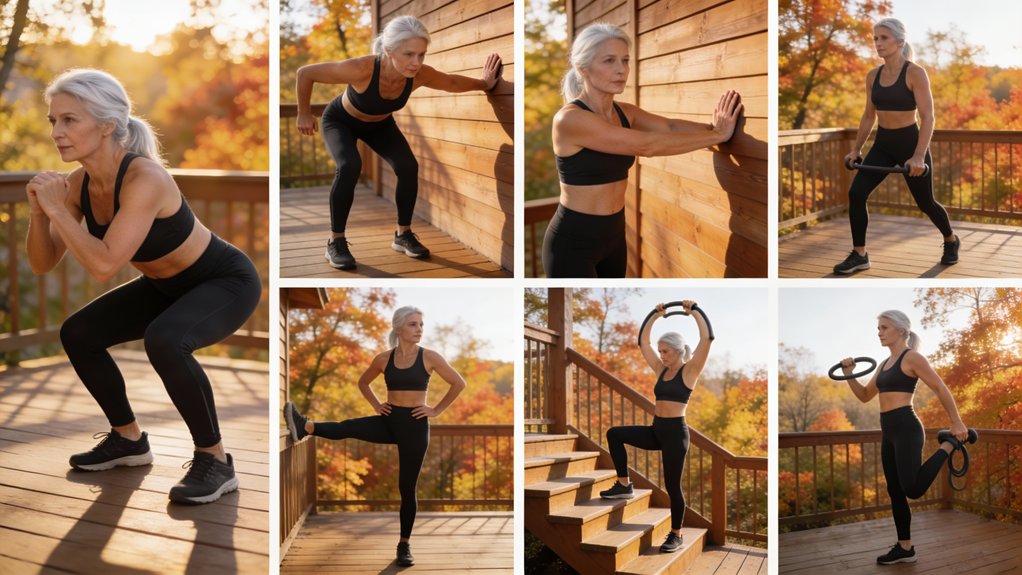
When you’re short on time but want to stay strong for walking, this routine gives you exactly what you need. You’ll work through six exercises that strengthen your core, legs, and balance, the foundation of confident walking.
Do this routine 3 times per week with at least one rest day between sessions. Your muscles need time to recover and get stronger.
Here’s the format: Move through each exercise below, spending about 90 seconds on each (including rest). The whole routine takes 10 minutes. As you get stronger, you can repeat the circuit twice.
These movements directly support your walking efficiency and help prevent falls, making everyday activities easier. Building joint strength and endurance through consistent strength training means your body can handle longer walks with better stability and less injury risk.
Hip Flexor Stretches to Lengthen Your Stride
Your hip flexors tighten naturally after years of sitting, and this restriction can shorten your walking stride by 2-4 inches on average. Tight hip flexors also pull you into a forward lean, which throws off your balance.
Daily stretching of these muscles gives you longer strides and better posture during your walks.
Two stretches that work:
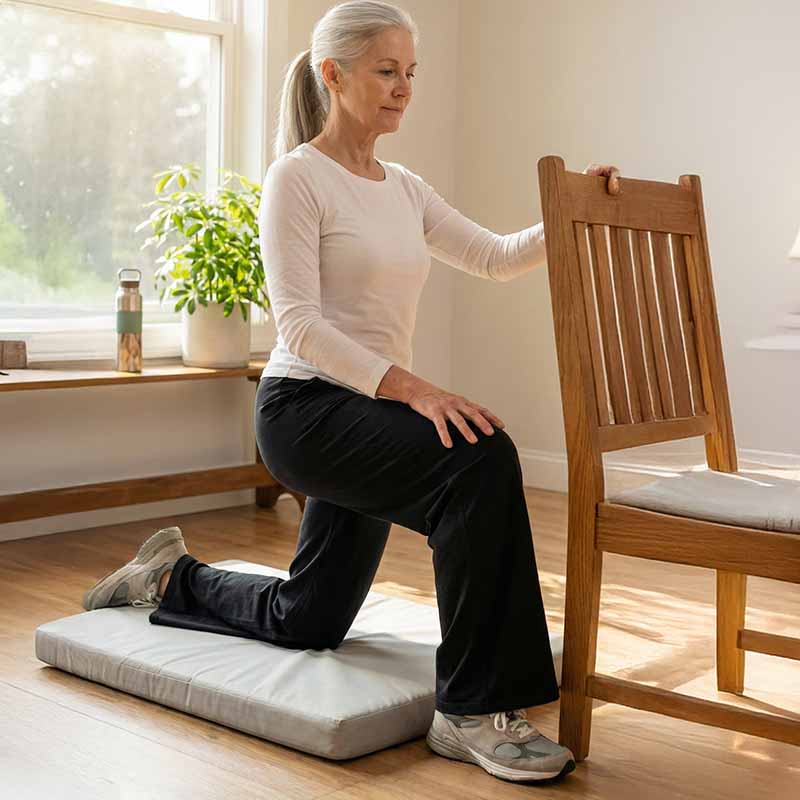
Kneeling lunge: Kneel on a soft mat or cushion on your right knee, left foot forward flat (like proposing). Hold a chair for balance. Keep back straight, gently shift hips forward until mild stretch in right hip front; don’t push hard. Hold 15-20 seconds breathing deeply, switch sides, 1-2 sets daily. Use cushions under knee, stop for pain, consult doctor for knee/hip issues.
Standing quad pull: Stand beside a sturdy chair or wall for support. Slowly bend your right knee, reach back to gently grasp your right ankle, and ease your heel toward your glutes while keeping knees together. Avoid strain. Tuck pelvis slightly by squeezing glutes for a mild front-hip and thigh stretch. Hold 15-20 seconds breathing deeply, switch legs, 1-2 sets daily. Never arch back or force; try seated version if unsteady, consult doctor for knee/hip issues.
Do these daily, and you’ll notice improved range of motion within two weeks. You’ll walk farther with less effort and maintain better energy throughout your day.
Regular stretching can also ease tightness and prevent pain that often limits mobility in walkers over fifty.
Glute Exercises for More Powerful Push-Off
Strong glutes generate the force that propels you forward with each step. Most walkers over 50 have weak glutes from years of sitting, which means you’re working harder than necessary with every walk.
Two simple exercises will boost your push-off power:
Glute bridges: Lie on your back with knees bent and feet flat on the floor, hip-width apart. Press through your heels to lift your hips until your body forms a straight line from shoulders to knees. Squeeze your glutes hard at the top, hold for 2 seconds, then lower slowly. Do 12 reps.
Squats: Stand with feet shoulder-width apart. Sit back like you’re lowering into a chair, keeping your weight in your heels and chest up. Go as low as comfortable (even a few inches helps), then drive through your heels to stand. Do 10 reps.
Make them harder: Loop a resistance band around your thighs (just above your knees) during both exercises. This forces your glutes to work harder to keep your knees aligned.
These exercises strengthen your hip extension and reduce injury risk while giving you the power to walk longer distances without fatigue.
Core Moves to Keep You Upright While Walking
A stable core acts as your body’s central support system, keeping you upright and balanced through every stride. Without proper core strength, you’ll tire faster and increase your fall risk, especially on uneven ground.
These three exercises strengthen the muscles that support your spine and pelvis:
Planks: Get on your forearms and toes (or knees if needed), keeping your body in a straight line. Don’t let your hips sag or stick up. Hold for 20-30 seconds. This builds foundational strength through your entire core.
Seated leg lifts: Sit in a sturdy chair with your back straight. Lift one knee toward your chest, hold for 2 seconds, then lower slowly. Do 10 reps per side. This improves the balance you need for walking on uneven surfaces.
Standing side bends: Stand with feet hip-width apart, hands on hips. Bend slowly to the right, then return to center. Bend to the left. Do 8 reps each direction. This strengthens your obliques, which keep you stable when the ground isn’t perfectly flat.
This targeted work improves your posture, reduces back pain, and helps you walk longer distances with confidence.
Ankle and Calf Exercises for Better Balance
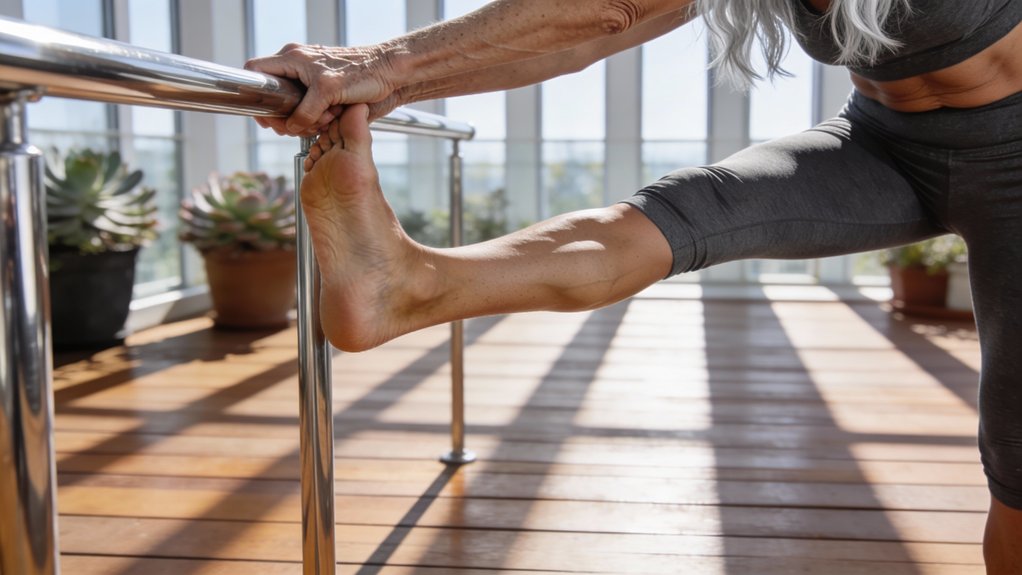
Every step you take depends on the often-overlooked muscles in your ankles and calves working together to keep you stable. Weak ankles are one of the biggest fall risks for walkers over 50.
Ankle circles: Sit or stand (hold something for balance if standing). Lift one foot slightly off the ground and draw circles with your toes: 10 rotations clockwise, then 10 counter-clockwise. This increases your range of motion for safer walking on uneven terrain.
Calf raises: Stand with feet hip-width apart, hands on a counter or wall for balance. Rise up onto your toes as high as comfortable, hold for 2 seconds, then lower slowly. Do 12-15 reps. This builds the power you need to push off with each step.
Single-leg balance: Stand near a wall or counter (don’t hold on unless you need to). Lift one foot a few inches off the ground and balance for 30 seconds. Switch feet. This directly improves your stability while walking.
Make them harder: Loop a resistance band around your feet during ankle circles for extra challenge.
These movements take just minutes but greatly reduce your fall risk while maintaining the independence that lets you stay active.
How to Progress Your Walking Strength Routine Safely
Once you’ve been doing this routine consistently for 3-4 weeks, you can start making it more challenging. The key is progressing slowly – your body needs time to adapt.
Start with these progressions:
Add a second round of the circuit (20 minutes total instead of 10). Rest for 1-2 minutes between rounds.
Increase reps gradually – add 2-3 reps to each exercise every week or two.
Add light weights to exercises like squats and side bends. Start with 3-5 pound dumbbells or even canned goods from your pantry.
During your walks, try interval training: Add 30-second speed bursts every 5 minutes. Walk at your normal pace, then pick it up to a brisk pace (breathing harder but still able to talk) for 30 seconds. This builds cardiovascular strength without overdoing it.
Watch for these warning signs you’re progressing too fast:
- Soreness that lasts more than 2 days
- Joint pain (dull ache is okay, sharp pain is not)
- Feeling exhausted instead of energized after workouts
- Difficulty sleeping due to muscle fatigue
If you notice any of these, dial back the intensity and give yourself more recovery time.
Consider working with a professional: A fitness trainer who specializes in clients over 50 can create a personalized routine that matches your specific goals and any limitations you might have. They’ll also check your form to make sure you’re doing exercises safely.
The goal isn’t to become a bodybuilder – it’s to stay strong enough to walk confidently, maintain your independence, and keep doing the activities you enjoy.